The 30th Annual Sri Chinmoy Self-Transcendence 3100 Mile Race

30 August - 20 October
Jamaica, Queens, New York

From August 30, the world's longest certified road race: 6 am to midnight for 52 days.

Latest updates Scoreboard Live Webcams Message the runners

About the event

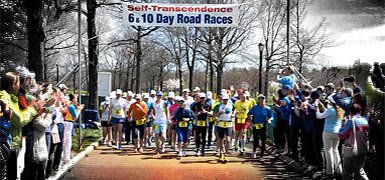
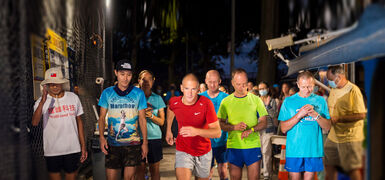
Athletes are able to test themselves in a format unlike any other ultra-marathon event. In order to meet their goal of 3100 miles (4989km) in 52 days, they must log an average of 59.6 miles (95.9 km) per day. The runners begin at 6 a.m. and run for extended periods throughout the day, taking breaks as needed. If they want to, they can continue as late as 12 midnight when the course closes for the night. After completing the race, runners have the option of continuing on to complete 5000km. Full details »

The race has been extensively covered by media around the world, including the BBC, Wall Street Journal and New York Times. Media coverage »

Latest updates

The day's news from our associate race director Sahishnu Szcsesiul, as well as videos and photos.

  • 1 of 1 videos & photos
8 October Day 39 - Sri Chinmoy 3100 Mile Race

Race report by Tarit Stott

Day 39 — Sri Chinmoy 3,100-Mile Race

  • Andrea Marcato remains in the lead, clocking 64.2 miles to take his race total to 2,687.7 miles.
  • Radu Budan topped the daily rankings with 66.9 miles, bringing his total to 2,593.4 miles.
  • Lo Wei Ming stayed steady with 63 miles, taking his cumulative distance to 2,486.4 miles.
  • Annabel Hepworth hit 61.9 miles for the day, finishing on a total of 2,463.9 miles.
  • Both Lo Wei Ming and Annabel should pass 2,500 miles later today.
  • Vasu Duzhiy maintained his metronomic pace with 61.4 miles for the day, taking him to a race total of 2,401.4 miles.
  • Nayaja Perugini had a few issues, resulting in a slightly lower daily mileage of 53.7 miles. Her race total now stands at 2,359.7 miles.
  • Nina clocked 50.4 miles to reach 2,000 miles just before the end of the day, finishing on 2,000.5 miles.
  • Stutisheel also clocked 50.5 miles, leaving him on 1,806.4 miles.
  • Ananda-Lahari ran 44.9 miles to finish on 1,805.2 miles, just over a mile behind Stutisheel.

Annabel with Harita, part 1

Annabel, photo Ben Cross

HARITA: Okay, hi Annabel. So, you're doing fantastically, and we've got a few questions for you, because you've got so many fans who are watching you and are so proud of you, and all struck by how strong and determined you are and how much energy you have. These are offered by Tarit, all the way from Scotland.

So — in this race you have now run further than you've ever run before.

ANNABEL: Indeed, yes.

HARITA: In 2024 you had an injury, so you had to pull out. What would you say was the most important thing you learned from that experience, and how do the two races compare? It seems to me you're almost a completely different person in this race.

ANNABEL: I feel like a different person in a lot of ways. I'm just in a really different place to where I was in 2024.

2024 — what can I say? I had a lot going on. I had an inappropriate foot care setup, to put it mildly. And that was as much on me, because I asked for it. I can be elbows out. It actually takes a bit, I think, for someone to say no to something I've asked for. And I'd asked for something I had no business asking for in a foot care setup.

HARITA: Maybe you could say a little more specifically what it was, because that's interesting for people in the future.

ANNABEL: There was a lot going on with my feet. They're an engineering marvel, really — pretty crazy feet. My toes are at funny angles, bunions, flat feet, and I'm seriously double-jointed. There's so much there, it's not funny.

But I had specifically asked somebody to make me an orthotic with a metatarsal dome, which is a thing that sits under the forefoot and, in theory, deloads it. Nothing wrong with metatarsal domes — they work for a lot of people. In this context they didn't work for me. And I had an ulcer going on under the foot where that was.

As I say, this is as much a reflection on me. I asked for it, thinking it would be the best thing ever. It wasn't — it didn't work out. And then you overlay all the things that are wrong with my feet, and that were wrong with the left foot in particular. There are a lot of them. You just had a bit of a ticking-time-bomb situation: that device, that foot, this surface, that distance. It was a recipe for disaster, really.

HARITA: Let's just say you learned a lot from it.

ANNABEL: I learned a huge amount, because I came out of 2024 thinking: what can we change, and what is absolutely baked in? All the structural stuff is only progressive. That's loose tissue, years of pounding. It isn't going to get better — realistically, it's going to get worse.

So what could I change? I did a few things. I did gait retraining. I went to a physiotherapist who does that, and he said, you know, I run a bit like a crab. I went in thinking I'd be told, "Just keep on running like a crab — there's the door." Actually he said no, we can definitely change this. So we changed it, so that my running mechanics are actually running mechanics, leaving my walk to be a walk.

HARITA: As an observer, you really did change it — you did some amazing work on that.

ANNABEL: I'd been in a kind of schism, doing this weird hybrid of the two, and I sort of sensed it wasn't optimal. So I changed that.

What else? I finally started seeing a PT. I'd had a programme from the physio for strength, but I cut a lot of corners. If it said single leg, I'd think double leg, and make it easy on myself. So I needed to pay someone to stand over me and put a stop to that nonsense.

And the other thing — I found a really good podiatrist in Sydney, who came highly recommended. I bowled on in and said, "So, you're going to make me an orthotic, and you're going to put a met dome in it." And I was really fortunate, because he said to me, here's why I don't think that's the right thing to do in the circumstances. It was what I needed to hear, not what I wanted to hear.

So quite a few things changed in how I approached the foot care and the whole chassis situation. And look, I'm fuelling better than I did in 2024. In the running world at the moment there's a stress fracture epidemic out there, and everyone's talking about energy availability. So I came into this race with a lot more awareness about energy and eating — a lot more carbs.

And I think a lot of what happened with my foot in 2024 was actually about unresolved issues I had in my life that were affecting me.

I guess this year I just had to confront things, and they've diminished. They've diminished from having been confronted — as opposed to this being the thing that nobody talks about. It's opened up a whole level of honesty about what's going on. It's really quite strange, actually. Quite profound for me. And it's influenced the whole way I've approached the foot care situation.

HARITA: Well, in a way that shows the connection with Sri Chinmoy's philosophy of the inner life — that everything starts from inside you.

ANNABEL: It does, yes. When you have these unresolved issues taking away your peace of mind and your focus from the race, they really do affect your experience. What's going on internally influences, in a really compelling way, what's going on externally: how you deal with the world, and how you deal with somebody who's there to give you advice and help you make a foot care device, if that's what you want.

It does influence whether you go in there elbows out and, through sheer force of personality, try to get someone to give you the service you want — or whether you actually use such a device once you've got it.

HARITA: Let me ask you something on a completely different level, because we're nearly at the end of this lap. What are your favourite shoes? And how many pairs do you think you'll have used?

ANNABEL: There are two. I wear Topo shoes because of my very wide, crazy toes — very much the Atmos and the Aura models at the moment. They're boring shoes, and boring is really good sometimes in a race.

I was wearing a shoe with more of the magic foam, from a super-shoe perspective, partly because I wanted to feel fast and tell myself I was doing laps at speeds greater than nine kilometres an hour or whatever. We're doing more like nine-minute kilometres, aren't we? And I wouldn't feel like I was going faster than nine-minute kilometres, which isn't really happening anyway. So that just felt too aggressive at the moment. I'm sticking with my boring shoes, and boring is fantastic.

HARITA: How many pairs do you think you'll have used by the end of this race?

ANNABEL: I've probably got twelve. I've got a feeling I'm going home with more than I came with.

HARITA: Right.

ANNABEL: I can't even go there. This is not going to go well for me when I get home.


Vajra and Aharan

The race has quite a few helpers who do an indispensable job in the background. Vajra cleans the course early in the morning and offers massage to runners. Aharan has become an expert in adjusting shoes to make it easier for the runner, this may involve making holes in the toes and other adjustments.


Follow the race

View all updates