
About the author:
Tejvan organises short-distance running and cycling races for the Sri Chinmoy Marathon Team in his home city of Oxford. He is also a very good cyclist, having won the National hill climb championships in 2013 and finished 3rd in the National 100 Mile Time Trials in 2014.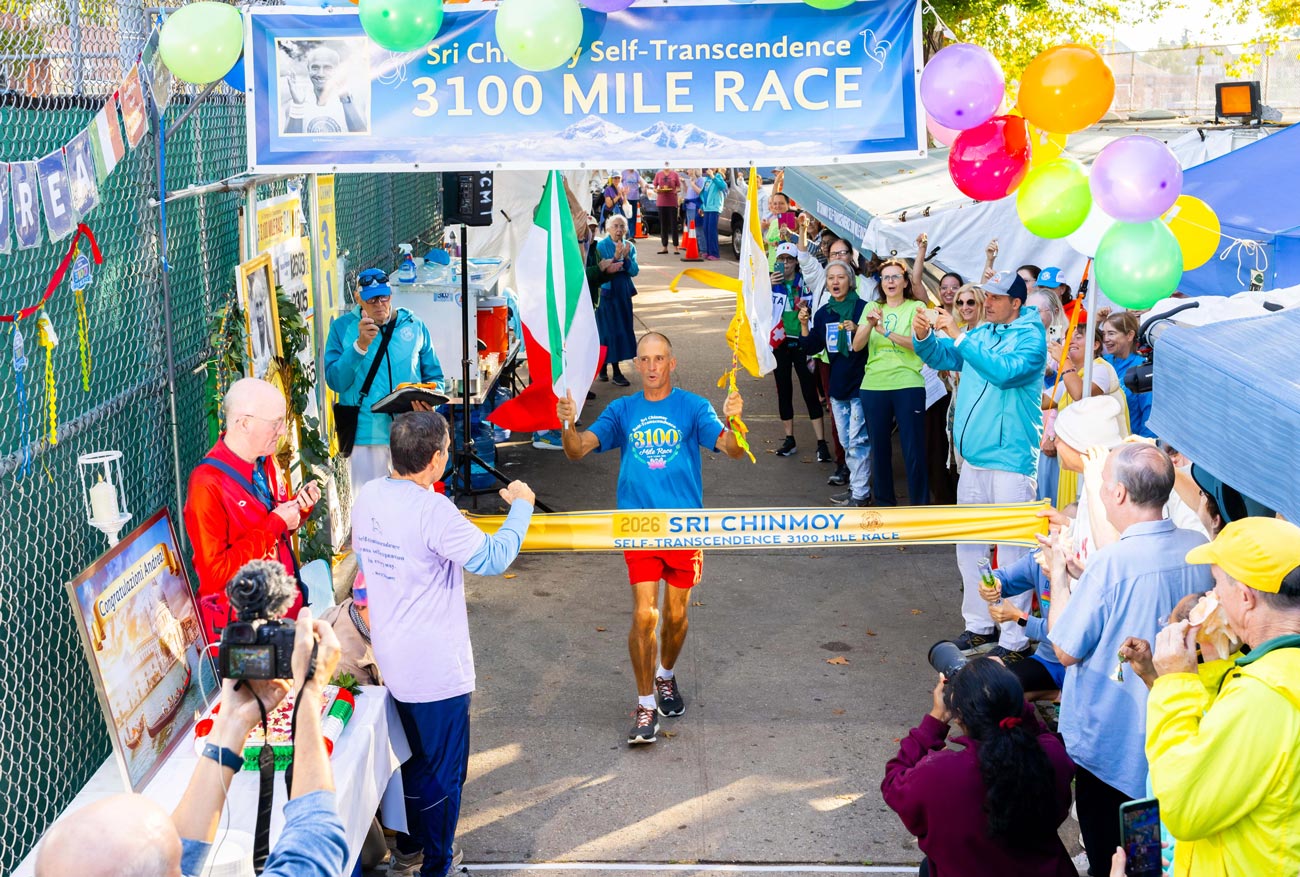
After the 3100 Mile Race, Tarit Stott sat down with Andrea Marcato and his main helper Arpan DeAngleo.
Andrea 1 — New Recording 23 Oct 2026, 14:46
TARIT: It’s been a week since the race. How has your recovery been?
ANDREA: Yesterday and today were the first two days that the body felt a little better. I felt rested and more recovered, so I’m really happy. The first two or three days after the race were pretty tough, and I could hardly move. I ran a few miles. I disciplined myself to do a few miles a day, just to keep going.
TARIT: How has recovery been this year compared with other years?
ANDREA: The very first year was extremely hard. It took me pretty much the whole year to come back. For the second edition, I was ready to go just one month before. But it’s a paradox: the more consecutive editions I ran, the better my recovery time became. I have to say it was never linear — it was up and down. After the fourth and fifth editions, I could really bounce back quickly. After one month I could run two miles in 12 minutes and 3 seconds, which was extraordinary. Other runners might run 14 or 15 minutes. So I bounced back pretty quickly. This year I had to wait and see how it would go, but the feeling is pretty good.
TARIT: Take us back to your early years as a swimmer. I know we’ve talked about it before, but for new people who don’t know your background, you were a very competent swimmer in your teenage years.
ANDREA: Yes. I remember that as a kid I was a little obsessed with performance. I gave everything I could possibly give in training. Competition was more difficult, because I had a lot of anxiety and I was never really relaxed. I was a bit of a lone wolf; I didn’t have much oneness with my teammates. There was friendship, of course, but nothing more than that. I was very introspective, and I wanted to be the best in the swimming pool in training — that was my mindset. I grew up as an only child, so I didn’t have a brother or sister to relate to.
Even at home, instead of going out with other kids, I would be in my room doing push-ups and pull-ups on the furniture. It was a spontaneous attitude towards sport and fitness. I remember it vividly.
TARIT: You’re being a bit reticent about the level you reached as a swimmer. Don’t be humble — tell us what level you got to.
ANDREA: First of all, I started very early, at the age of four, and I also dropped out very early, at the age of 12. Then I took it up again at 16 or 17 for a few years. So I missed the best years for developing as a professional swimmer.
In Italy, below the national level you have the regional level. Italy is divided into 21 regions. At the age of 12 I was one of the best in my region. The best in each region eventually make it to the national championships. That never happened for me. I was always very close — the potential was there and my times were extremely good.
So I never swam at a national competition, but at regional level I was extremely good, and I was close to being chosen for the so-called top 10 in the whole region — the 10 best swimmers out of a population of, I don’t know, three million people. I remember a very big disappointment, because I was the best in three strokes in my swimming club, but they unexpectedly chose another boy to go instead of me. In my mind I knew I was good enough to make the top 10, but it didn’t happen. And I knew that the more you train with strong people, the stronger you become. That’s a very well-known law in sport — you develop much better when you train with better athletes. So I had this strong disappointment, and the next year I decided to leave the team. That was it.
I asked the coach, or perhaps I overheard what the coaches said. To me it was clear that I was the best, but they promoted this other boy because he was taller. That was the main reason. And he was so tall that the next year he went off to play basketball, so it was a lose-lose situation. I had the drive to keep going and I got disappointed; he probably had some intrinsic physical advantages, but he didn’t use them. As a child you can get very disappointed and emotionally affected, and then you make the wrong decision.
TARIT: You’ve talked before about how you developed into marathons, six-day and 10-day races. Was there one event that made you think you wanted to do the 3100 for the first time — or that you were capable of doing it?
See the previous interview with Andrea after his 2024 victory:
ANDREA: It was in 2018. I ran my very first 10-day race in Flushing Meadows, New York, and I surprised myself.
At the very first attempt I ran more than 1,000 kilometres — around 630 miles. It was probably the toughest race I have ever been through. I really gave everything and I was on the limit of the limits, but it gave me the confidence that the 3,100-mile race was doable. I knew that this was one of the requirements for the 3,100-mile race — you have to be capable of running more than 620 miles, or a thousand kilometres, in a 10-day race — so I sent an email to the organisers.
NOTE: Andrea ran 1014.530 km (630.3997 miles) in his first 10-day race, the Sri Chinmoy 10-Day Race at Flushing Meadows, New York, in April 2018.
They told me, “You can do it, but you have to prove yourself again.” So the next year, in 2019, I ran the 10-day race once more and had a very similar result, a little better — 1036.417 km (644 miles) — and it seemed like much less effort. My body had got used to the high mileage, and I could sleep much better.
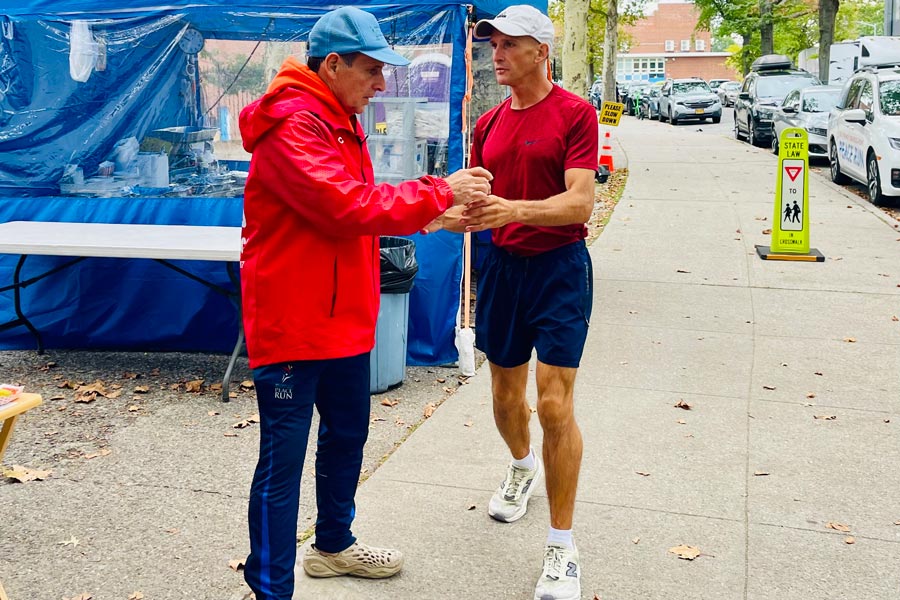
I did it better because I made one big change: I ran it with very long rest periods, five or six hours at a time, which is the same approach as the Sri Chinmoy 3100 Mile Race, where you have the overnight break.
So I thought: the first year was very tough; the second year I got the same result with much less effort and a lot of resting time. Maybe I’m ready. I wrote to the organisers again, and again I got a no.
Then, a few months later, I think some of the runners who were due to participate that year said they weren’t sure they could do it, so the organisers kept me in consideration.
I forgot to mention that the COVID pandemic broke out at the end of December 2019. Because of government regulations, they said the race was not going to happen in New York that year.
Then there was an idea to hold the race in Salzburg, Austria. Even then, right up to August, I got negative feedback from the Austrian organisers. Eventually they said, “Okay, this year it’s not going to happen.” When they told me that, I felt very relieved — I felt I had escaped something big.
Part of me wanted to go, but I thought, maybe it’s good that it didn’t happen. Then, 10 days before the Salzburg start, the organiser called me and said, “Look, we are going to make it. We have permission, but it will be a very small number of runners — five maximum.” And then he asked, “Do you want to be part of it?”
That was the most difficult thing. It took me two hours to say yes. After two hours I called him back and said, “Okay, I’ll do it.” For me it was like jumping into the void; it was so difficult to accept.
But everything went well, and I had probably the best debut in the history of the race: 43 days at the first attempt, which is very, very good. I was super happy.
Note: Andrea ran 43 days, 12 hours, 7 minutes and 26 seconds. At the time, this was the sixth-fastest time in the history of the race.
TARIT: So you’ve just finished race number seven.
ANDREA: Yes.
TARIT: And, to clarify, it’s your seventh victory. You haven’t only run and finished the race seven times — you’ve won all seven! What keeps you coming back?
ANDREA: Wow. In a way it’s a very simple question.
The simple answer is that I want to do better, to transcend myself — to run the race in 42 days. I would like to run faster and bring the time down. That’s the main reason.
But there are many other things that bring me to the starting line year after year. One is the sense of routine I’ve developed. It’s a pleasure for me to be part of the race.
I see my friends. And I think it’s also a very long-term health investment.
I also have this feeling that, because the intensity isn’t as hard as in a marathon, you can really feel your body and you get good feedback from it.
TARIT: In practical terms, how do you divide up each day? Do you plan it, or is it spontaneous?
ANDREA: Pretty much both. I have a kind of internal daily goal for the miles I want to achieve.
But at the same time I try to feel the potential of the body on that particular day, and I try to give my best with what I have.
For the first five editions, I could do whatever I had in mind. If I wanted to do 70 miles, then 95 per cent of the time I ran those 70 miles by the end of the day, and that was very rewarding for me.
The past two years have been extremely tough. Last year I had some injuries, but I just kept going. This year was a little better, although I was still far from what I consider my true standard. You have to accept that every year is different.
So I have a daily goal, but at the same time I try to feel what the body can really do in the current situation.
TARIT: In terms of other practical things, how often and how much do you eat? Do you have a plan for each day, or is it more spontaneous?
ANDREA: No — the eating is definitely my weak point. I’m so focused on running that I have to be careful, because I easily start to overeat, and I’ll eat whatever people give me. People are very nice, so they hand me all kinds of sweets and food.
Luckily I have my helper and nutritional adviser, Arpan De Angelo. He keeps me in check. He always suggests things in a very nice way: “Hey, are you going to eat all that? Try to eat better, try to reduce the sugar, try to have a clean diet.”
Day after day I get this feedback from him, and I really appreciate it, because it is hard. I want to eat whatever comes easily, so I appreciate that he makes a big effort to keep my diet healthy. The nutritional side of the race is extremely important, and if it were up to me I would really be in trouble.
TARIT: There’s a theory among many multi-day runners that too much sugar is not good.
ANDREA: Yes, I’ve experienced that. In a short race like a 24-hour race or a marathon, you can get through on plenty of sugar; it’s not a big deal. But when you switch to a multi-day event, you see the long-term picture and how much bad nutrition — or non-optimal nutrition — can affect performance.
Losing even one or two days can be the difference between winning the race and finishing third or fourth. The nutritional side is really important and plays a very big role.
TARIT: Do you often feel that you’re not just eating for that particular day, but that what you’re eating will sustain you in two or three days’ time?
ANDREA: Yes, absolutely. You feel that the body and the mind are craving food, as if to fill some emotional gap.
And you can see your body getting leaner and leaner. You see that you’re losing weight and looking leaner. You feel extremely well, but at the same time you sense that this isn’t your normal weight, so you tend to overeat even when there’s no need for it — because the body always finds the balance that is optimal for that specific moment.
TARIT: Do you monitor your weight — if not during the race, then at the end of it? Are you aware of how much weight you’ve lost?
ANDREA: Yes, we have some statistics. I normally lose weight, and in my case you really see it. It can be as much as 25 pounds — 12 or 13 kilos — in just 40 days or a little more. It’s really massive.
At the start I tend to be a little muscular; I bulk up. And then in my case you see a lot of weight loss. With other runners you may see a bit less. I think they’re leaner at the beginning, so they don’t lose as much as I do.
TARIT: How long does it take you to put the weight back on?
ANDREA: It’s pretty fast. The day after tomorrow it will be 10 days since my finish, and I’ve already put back almost 10 pounds. So the recovery, or the weight compensation, is pretty quick.
I have to be careful not to overdo it, but I think the body has its own intelligence and builds itself back up.
TARIT: In a race like this, do you sometimes forget to eat?
ANDREA: In very specific moments of the race, when I have a strong drive to reach an intermediate goal, I become so mentally driven — or maybe I put too much stress on myself — that I can go for a few hours without eating, almost on purpose.
Let’s say I want to reach 70 miles by the end of the day and I’m a little behind schedule: I just forget about eating and push myself through the last hour or two in order to reach my goal.
TARIT: In terms of resting, you’re one of the runners who stays fairly close to the race. The race runs until midnight; then you get on your bicycle and cycle home.
ANDREA: Yes.
TARIT: How long a ride is it?
ANDREA: The ride from the race to home is short — just a little more than a kilometre, about half a mile. My accommodation is quite close to the race.
TARIT: Once you get home, you have to sort yourself out — your feet, a shower. When do you actually get to sleep, and how much sleep do you get before you come back the next day?
ANDREA: That’s very interesting. I try to get to sleep around 12.30 a.m. and wake up at 5.30 a.m., so I try to get five hours — but that’s only in theory, because it never really happens.
Some days you have to do more stretching, or it’s hard to fall asleep, so you don’t get to sleep until a quarter to one.
So I’d say I get less than five hours on average, but I try to make it five.
TARIT: You mentioned stretching. That’s important to a lot of the runners, because long-distance running is a classic way to shorten all the main muscle groups. How important is stretching to you and the other runners in a multi-day race like this, and which stretches do you do?
ANDREA: I try to have my stretching session at the end of the day — at 1 a.m. at home — or at the beginning of the day, before 6 a.m., before the start. That’s when I stretch the most.
I try not to stretch too much during the race unless it’s strictly necessary. My theory is that I’m not as fast as other runners, so I need to just keep going, even in a long race. For me it’s important to put in the laps each day, so I stretch on the go.
I have quite a peculiar style, as you’ll see if you come to the race: I lift my legs every 30 or 40 metres and stretch my back while moving. I try to do everything on the go.
Other runners may stop for a while, but I keep moving.
TARIT: With the lack of sleep, do you ever feel tired during the day? Some of the runners go and lie down for a 30-minute power nap, sometimes even an hour. You don’t seem to do that very much, but do you actually feel tired during the day?
ANDREA: In general, no — but I’m conscious that in my case the tiredness accumulates.
For the first 10 days I don’t feel anything, and then on day 11 I may lose 20 miles because I’m literally falling asleep on the course and I’m very slow.
So the body takes its rest either in small chunks or all at once in a single day. If the body needs rest, it will take it.
I’m conscious of this, and I would like to prolong my resilience. I’d like not to be affected by the lack of sleep, but it happens — every 15 or 20 days you get a low-mileage day.
TARIT: Last year, in 2025, you had a big problem with your foot, and it seemed to slow you down quite a lot. Did you have any problems with injuries this year? Did anything really slow you down?
ANDREA: No, I didn’t have any injuries this year, but I lost many miles in the middle of the race over a few days because I got food poisoning.
It happened exactly in the middle of the race. I wasn’t clear what it was. I did 40 or 45 miles in a day, which in my case is extremely low mileage. It just happened, and I accepted it. I got scared immediately, because I thought: something is wrong, I’ll have to walk for the rest of the race.
But then I picked it up again, and I was extremely happy, because this year I finished in 45 days and three hours. Starting the very last full day, I was on 3,086 miles, so it was just 14 miles to go.
I could easily have finished under 44 days, but because of those two days of extremely low mileage due to sickness, I couldn’t pick it up and compensate.
Otherwise, this year I could have run 44 days, which is very close to my 43 days, so I was happy.
TARIT: Maybe a final question. You’ve now run the race seven times. It’s probably too soon to ask whether you’re coming back for number eight — it’s never the right time straight afterwards; you need to recover. But do you ever feel that one year you’d like to take on another challenge?
ANDREA: As I said, I’m a former swimmer, and the swimming world still appeals to me. I feel I can still give something there — maybe in open-water swimming, or long-distance swimming in the pool.
TARIT: Would you take on one of the classic open-water swims, like the English Channel or the Straits of Gibraltar?
ANDREA: I’ve been asked this many times. Distance-wise I’d have absolutely no problem. The issue with the English Channel is the temperature. Although I’m fine running in the cold in winter, cold open water is a very big challenge for me.
I tried a few open-water races and came out completely blue and almost hypothermic. It was a little dangerous.
But I believe you can train for anything, and I probably don’t have enough body fat to cope with the cold water of the Channel. I’d have to take a totally different approach.
TARIT: You’re obviously happy running multi-day races on the roads. Do you ever think of doing any of the classic trail races, like the Spartathlon or the Alpine races, rather than road events?
ANDREA: I’m quite happy with the loop races, and I believe they’re the best for performance. Given my mental attitude, I really like the short loop and the fact that all the logistics are taken care of: the food is close by, there are restrooms, massage if necessary — everything is there.
I’ve never thought about the Spartathlon or long-distance trail running. It would be interesting to consider sometime in the future, but for the time being I like the loop races.
TARIT: What is your favourite food at the race?
ANDREA: I like rice crisps with crème fraîche and almond butter. It’s a very light thing to eat — you can have a lot of them and they still don’t affect your stomach much.
TARIT: We’ve been joined, spontaneously, by Arpan, who is Andrea’s great adviser, coach and mentor.
ANDREA: Absolutely.
TARIT: Arpan, what is Andrea like to look after in a race?
ARPAN: First of all, there’s his natural personality. He has a lot of determination. He sets very high goals and he tries to reach them. He gets a little frustrated when he can’t reach some of them, but he also understands why, and we always discuss any problems.
We don’t always agree, but he always listens to me. I let him do what he wants, because he’s an adult and he’s doing all the work. So we never argue about it. We never really fight or yell at each other.
We sometimes disagree, but we definitely get along, and that’s why we’ve been together so long. My advice may not always be the best, and then he’ll find his own solutions. I think that’s great, because he’s the one experiencing the physical and mental stress of the race. I just try to help him along and perhaps make it a little easier. I don’t know everything.
Even though I’ve run the 3100 and many other multi-day races, I’ve never run at his level. His level is very, very high.
TARIT: Do you give Andrea any advice in the weeks before the 3100 — how to get fit and prepared? Or is the race just something you start and work your way into?
ARPAN: He loves racing, and I try to stop him doing too many races right before the event. This year was the first year he didn’t do a marathon, and then a 47-mile race a week later, in the build-up to the 3100. So I think he had more reserve strength this time.
I think he did the best he could, apart from the stomach problem. He was getting close to 43 days again — he could have gone under 44 days.
But you have to accept your body’s limitations too. Sometimes you’re just not at your peak.
If you train properly and rest properly — tapering before a race — it’s good to have a week of easy jogging. You can’t really gain anything in the last week or so from your training by pushing hard. What you gain is reserve strength if you taper and save everything for the race itself, rather than throwing it into your training.
I think he races enough that his training doesn’t have to go all the way to the last week of August. I think the whole month of August before the 3100 should be tapering, maybe with a few short races.
ANDREA: I had a big event exactly one month before, and I really pushed it. I set a new PB this year in the 48-hour race in Kladno, Czech Republic, in early August. I was happy — I ran 331 kilometres (205 miles) — but, as Arpan said, maybe it was too close to the start of the 3,100-mile race and I may have put in too much effort. So I really have to be careful to taper properly. Many elements are needed for a good race. It’s like a puzzle, and every part matters: the tapering, the nutrition, your general condition, your psychological state. Arpan really helped with a lot of that, and he kept asking me to keep going. He advised me many times. For example, I might get completely caught in a negative state of mind and start walking. From time to time he’ll tell me to run the little downhills, just to run another 20 metres. At first it feels like an imposition, or I feel he doesn’t understand.
But after a while part of me accepts the suggestion, and I see that it actually works. So if I’ve been struggling for three or five hours and he tells me to keep running a little from time to time, then mostly — sometimes even unwillingly — I do what he suggests. I start to run, and slowly, after half an hour or an hour, the energy comes back and the muscles become active again. It’s very easy to get stuck in a rut, a psychological rut. If you have someone outside who checks on you and tells you something, it’s very wise to listen. That’s what I’ve learned.
ARPAN: I’ve been running and racing for over 50 years, and even though I’ve only run two of these 3,100-mile races, what you learn from racing is how to train and recover well. I think the most important part of training is recovery.
It’s like interval work: you run a fast 400 metres and then recover by jogging. But on a larger scale — I’ve done over 400 marathons and multi-day races, and Tarit, you’ve done the same — if you race regularly you don’t have to kill yourself in training, because you need recovery to get strong. You still run, but you don’t push every day. It’s the same in this race, because it’s a two-month race.
So you have to understand that recovery is a very important aspect of this race, and he doesn’t rest much. As a matter of fact, in 2021, in his first race, when he did his PR of just under 43 days, we used to take 10- to 12-minute breaks two or three times a day. He’d lie down and I’d massage his feet, and he would sleep for a little while.
Just getting your legs flat, or even raised, to take the blood pressure and stress off your feet, really helps. He doesn’t do that now, and although I still suggest it, he understands that you have to walk sometimes, because you have to recover.
He has a very good walking speed — sometimes I can’t keep up with him even when I’m jogging. But he always wants to really push himself. I think he also realises that walking is important. You’re just moving forward slightly more slowly than running, but the mileometer is still running and logging the miles. Nobody runs the whole way in this race. Even Ashprihanal, the current record holder, walked a lot of miles. Ashprihanal was a very light, very fast runner, but he would walk fast too, when he had to.
Andrea generally wants to do a marathon by noon — that was usually his goal, which is 48 laps. And when you don’t reach it, you have to be happy with what you’ve done. Let’s say 40 laps is not so good for him; 45 laps was okay. So I try to keep his mind a little more tame, because he thinks a lot and he analyses a lot. And when you do that, it takes your energy away from the awareness of what your body is going through. It’s hard to explain, but there’s a real psychology to this race. In certain ways I was probably more of a psychologist than a nutritionist. I just wanted to see him happy. If he’s happy, then I’m happy.
TARIT: One final question. For anyone reading this article who has a dream of running the 3,100-mile race, what would be your best advice? Or what would be your best advice to your younger self, before you even started?
ANDREA: In general, I would definitely say: consistency over emotional rush. It’s better to build up gradually to whatever the goal is, even if it’s the longest certified footrace in the world, like the 3,100-mile race. Whatever your goal, it always pays to be consistent and train regularly, rather than training two or three times a week with high mileage.
It’s better to train six days a week with consistent, regular mileage and proper rest. With that consistency you can build something. If you just run high mileage on a couple of days a week, you’re only going to hurt yourself, and you won’t build the base you need to sustain the race over the long term. So it always pays to train six days a week when you have the time.

 More about: