Tejvan organises short-distance running and cycling races for the Sri Chinmoy Marathon Team in his home city of Oxford. He is also a very good cyclist, having won the National hill climb championships in 2013 and finished 3rd in the National 100 Mile Time Trials in 2014.
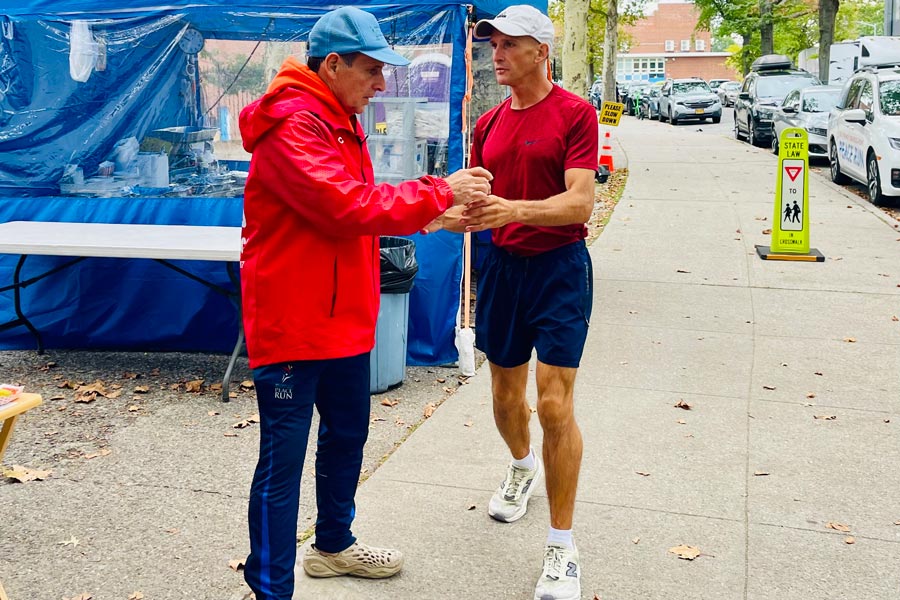
After the 3100 Mile Race, Tarit Stott sat down with Andrea Marcato and his main helper Arpan DeAngleo.
Andrea 1 — New Recording 23 Oct 2026, 14:46
TARIT: It’s been a week since the race. How has your recovery been?
ANDREA: Yesterday and today were the first two days that the body felt a little better. I felt rested and more recovered, so I’m really happy. The first two or three days after the race were pretty tough, and I could hardly move. I ran a few miles. I disciplined myself to do a few miles a day, just to keep going.
TARIT: How has recovery been this year compared with other years?
ANDREA: The very first year was extremely hard. It took me pretty much the whole year to come back. For the second edition, I was ready to go just one month before. But it’s a paradox: the more consecutive editions I ran, the better my recovery time became. I have to say it was never linear — it was up and down. After the fourth and fifth editions, I could really bounce back quickly. After one month I could run two miles in 12 minutes and 3 seconds, which was extraordinary. Other runners might run 14 or 15 minutes. So I bounced back pretty quickly. This year I had to wait and see how it would go, but the feeling is pretty good.
TARIT: Take us back to your early years as a swimmer. I know we’ve talked about it before, but for new people who don’t know your background, you were a very competent swimmer in your teenage years.
ANDREA: Yes. I remember that as a kid I was a little obsessed with performance. I gave everything I could possibly give in training. Competition was more difficult, because I had a lot of anxiety and I was never really relaxed. I was a bit of a lone wolf; I didn’t have much oneness with my teammates. There was friendship, of course, but nothing more than that. I was very introspective, and I wanted to be the best in the swimming pool in training — that was my mindset. I grew up as an only child, so I didn’t have a brother or sister to relate to.
Even at home, instead of going out with other kids, I would be in my room doing push-ups and pull-ups on the furniture. It was a spontaneous attitude towards sport and fitness. I remember it vividly.
TARIT: You’re being a bit reticent about the level you reached as a swimmer. Don’t be humble — tell us what level you got to.
ANDREA: First of all, I started very early, at the age of four, and I also dropped out very early, at the age of 12. Then I took it up again at 16 or 17 for a few years. So I missed the best years for developing as a professional swimmer.
In Italy, below the national level you have the regional level. Italy is divided into 21 regions. At the age of 12 I was one of the best in my region. The best in each region eventually make it to the national championships. That never happened for me. I was always very close — the potential was there and my times were extremely good.
So I never swam at a national competition, but at regional level I was extremely good, and I was close to being chosen for the so-called top 10 in the whole region — the 10 best swimmers out of a population of, I don’t know, three million people. I remember a very big disappointment, because I was the best in three strokes in my swimming club, but they unexpectedly chose another boy to go instead of me. In my mind I knew I was good enough to make the top 10, but it didn’t happen. And I knew that the more you train with strong people, the stronger you become. That’s a very well-known law in sport — you develop much better when you train with better athletes. So I had this strong disappointment, and the next year I decided to leave the team. That was it.
I asked the coach, or perhaps I overheard what the coaches said. To me it was clear that I was the best, but they promoted this other boy because he was taller. That was the main reason. And he was so tall that the next year he went off to play basketball, so it was a lose-lose situation. I had the drive to keep going and I got disappointed; he probably had some intrinsic physical advantages, but he didn’t use them. As a child you can get very disappointed and emotionally affected, and then you make the wrong decision.
TARIT: You’ve talked before about how you developed into marathons, six-day and 10-day races. Was there one event that made you think you wanted to do the 3100 for the first time — or that you were capable of doing it?
ANDREA: It was in 2018. I ran my very first 10-day race in Flushing Meadows, New York, and I surprised myself.
At the very first attempt I ran more than 1,000 kilometres — around 630 miles. It was probably the toughest race I have ever been through. I really gave everything and I was on the limit of the limits, but it gave me the confidence that the 3,100-mile race was doable. I knew that this was one of the requirements for the 3,100-mile race — you have to be capable of running more than 620 miles, or a thousand kilometres, in a 10-day race — so I sent an email to the organisers.
NOTE: Andrea ran 1014.530 km (630.3997 miles) in his first 10-day race, the Sri Chinmoy 10-Day Race at Flushing Meadows, New York, in April 2018.
They told me, “You can do it, but you have to prove yourself again.” So the next year, in 2019, I ran the 10-day race once more and had a very similar result, a little better — 1036.417 km (644 miles) — and it seemed like much less effort. My body had got used to the high mileage, and I could sleep much better.
Arpan left. Andrea Right
I did it better because I made one big change: I ran it with very long rest periods, five or six hours at a time, which is the same approach as the Sri Chinmoy 3100 Mile Race, where you have the overnight break.
So I thought: the first year was very tough; the second year I got the same result with much less effort and a lot of resting time. Maybe I’m ready. I wrote to the organisers again, and again I got a no.
Then, a few months later, I think some of the runners who were due to participate that year said they weren’t sure they could do it, so the organisers kept me in consideration.
I forgot to mention that the COVID pandemic broke out at the end of December 2019. Because of government regulations, they said the race was not going to happen in New York that year.
Then there was an idea to hold the race in Salzburg, Austria. Even then, right up to August, I got negative feedback from the Austrian organisers. Eventually they said, “Okay, this year it’s not going to happen.” When they told me that, I felt very relieved — I felt I had escaped something big.
Part of me wanted to go, but I thought, maybe it’s good that it didn’t happen. Then, 10 days before the Salzburg start, the organiser called me and said, “Look, we are going to make it. We have permission, but it will be a very small number of runners — five maximum.” And then he asked, “Do you want to be part of it?”
That was the most difficult thing. It took me two hours to say yes. After two hours I called him back and said, “Okay, I’ll do it.” For me it was like jumping into the void; it was so difficult to accept.
But everything went well, and I had probably the best debut in the history of the race: 43 days at the first attempt, which is very, very good. I was super happy.
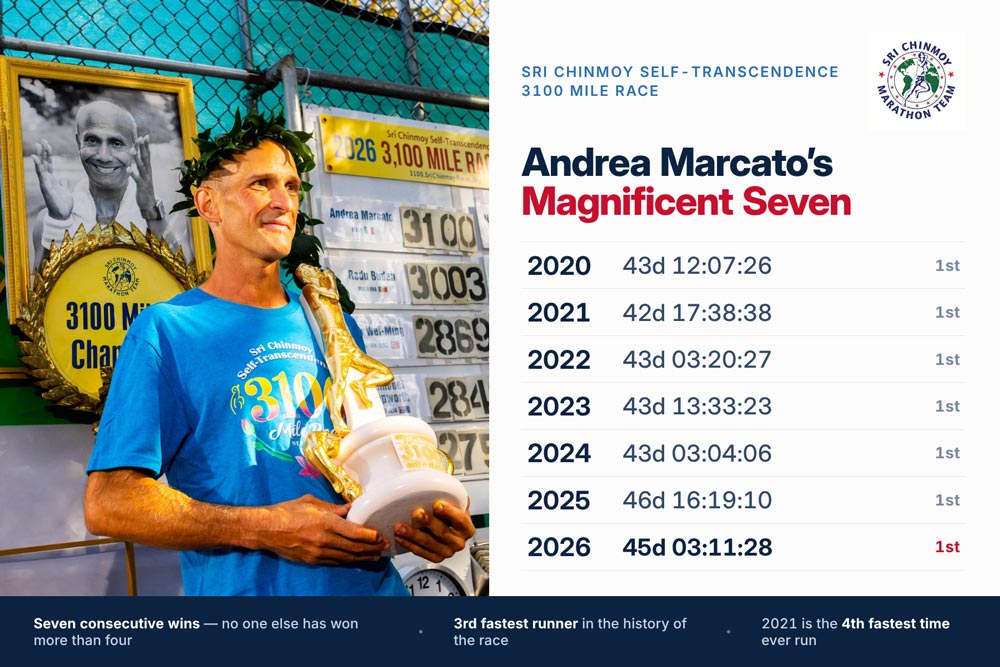
Note: Andrea ran 43 days, 12 hours, 7 minutes and 26 seconds. At the time, this was the sixth-fastest time in the history of the race.
TARIT: So you’ve just finished race number seven.
ANDREA: Yes.
TARIT: And, to clarify, it’s your seventh victory. You haven’t only run and finished the race seven times — you’ve won all seven! What keeps you coming back?
ANDREA: Wow. In a way it’s a very simple question.
The simple answer is that I want to do better, to transcend myself — to run the race in 42 days. I would like to run faster and bring the time down. That’s the main reason.
But there are many other things that bring me to the starting line year after year. One is the sense of routine I’ve developed. It’s a pleasure for me to be part of the race.
I see my friends. And I think it’s also a very long-term health investment.
I also have this feeling that, because the intensity isn’t as hard as in a marathon, you can really feel your body and you get good feedback from it.
TARIT: In practical terms, how do you divide up each day? Do you plan it, or is it spontaneous?
ANDREA: Pretty much both. I have a kind of internal daily goal for the miles I want to achieve.
But at the same time I try to feel the potential of the body on that particular day, and I try to give my best with what I have.
For the first five editions, I could do whatever I had in mind. If I wanted to do 70 miles, then 95 per cent of the time I ran those 70 miles by the end of the day, and that was very rewarding for me.
The past two years have been extremely tough. Last year I had some injuries, but I just kept going. This year was a little better, although I was still far from what I consider my true standard. You have to accept that every year is different.
So I have a daily goal, but at the same time I try to feel what the body can really do in the current situation.
TARIT: In terms of other practical things, how often and how much do you eat? Do you have a plan for each day, or is it more spontaneous?
ANDREA: No — the eating is definitely my weak point. I’m so focused on running that I have to be careful, because I easily start to overeat, and I’ll eat whatever people give me. People are very nice, so they hand me all kinds of sweets and food.
Luckily I have my helper and nutritional adviser, Arpan De Angelo. He keeps me in check. He always suggests things in a very nice way: “Hey, are you going to eat all that? Try to eat better, try to reduce the sugar, try to have a clean diet.”
Day after day I get this feedback from him, and I really appreciate it, because it is hard. I want to eat whatever comes easily, so I appreciate that he makes a big effort to keep my diet healthy. The nutritional side of the race is extremely important, and if it were up to me I would really be in trouble.
TARIT: There’s a theory among many multi-day runners that too much sugar is not good.
ANDREA: Yes, I’ve experienced that. In a short race like a 24-hour race or a marathon, you can get through on plenty of sugar; it’s not a big deal. But when you switch to a multi-day event, you see the long-term picture and how much bad nutrition — or non-optimal nutrition — can affect performance.
Losing even one or two days can be the difference between winning the race and finishing third or fourth. The nutritional side is really important and plays a very big role.
TARIT: Do you often feel that you’re not just eating for that particular day, but that what you’re eating will sustain you in two or three days’ time?
ANDREA: Yes, absolutely. You feel that the body and the mind are craving food, as if to fill some emotional gap.
And you can see your body getting leaner and leaner. You see that you’re losing weight and looking leaner. You feel extremely well, but at the same time you sense that this isn’t your normal weight, so you tend to overeat even when there’s no need for it — because the body always finds the balance that is optimal for that specific moment.
TARIT: Do you monitor your weight — if not during the race, then at the end of it? Are you aware of how much weight you’ve lost?
ANDREA: Yes, we have some statistics. I normally lose weight, and in my case you really see it. It can be as much as 25 pounds — 12 or 13 kilos — in just 40 days or a little more. It’s really massive.
At the start I tend to be a little muscular; I bulk up. And then in my case you see a lot of weight loss. With other runners you may see a bit less. I think they’re leaner at the beginning, so they don’t lose as much as I do.
TARIT: How long does it take you to put the weight back on?
ANDREA: It’s pretty fast. The day after tomorrow it will be 10 days since my finish, and I’ve already put back almost 10 pounds. So the recovery, or the weight compensation, is pretty quick.
I have to be careful not to overdo it, but I think the body has its own intelligence and builds itself back up.
TARIT: In a race like this, do you sometimes forget to eat?
ANDREA: In very specific moments of the race, when I have a strong drive to reach an intermediate goal, I become so mentally driven — or maybe I put too much stress on myself — that I can go for a few hours without eating, almost on purpose.
Let’s say I want to reach 70 miles by the end of the day and I’m a little behind schedule: I just forget about eating and push myself through the last hour or two in order to reach my goal.
TARIT: In terms of resting, you’re one of the runners who stays fairly close to the race. The race runs until midnight; then you get on your bicycle and cycle home.
ANDREA: Yes.
TARIT: How long a ride is it?
ANDREA: The ride from the race to home is short — just a little more than a kilometre, about half a mile. My accommodation is quite close to the race.
TARIT: Once you get home, you have to sort yourself out — your feet, a shower. When do you actually get to sleep, and how much sleep do you get before you come back the next day?
ANDREA: That’s very interesting. I try to get to sleep around 12.30 a.m. and wake up at 5.30 a.m., so I try to get five hours — but that’s only in theory, because it never really happens.
Some days you have to do more stretching, or it’s hard to fall asleep, so you don’t get to sleep until a quarter to one.
So I’d say I get less than five hours on average, but I try to make it five.
TARIT: You mentioned stretching. That’s important to a lot of the runners, because long-distance running is a classic way to shorten all the main muscle groups. How important is stretching to you and the other runners in a multi-day race like this, and which stretches do you do?
ANDREA: I try to have my stretching session at the end of the day — at 1 a.m. at home — or at the beginning of the day, before 6 a.m., before the start. That’s when I stretch the most.
I try not to stretch too much during the race unless it’s strictly necessary. My theory is that I’m not as fast as other runners, so I need to just keep going, even in a long race. For me it’s important to put in the laps each day, so I stretch on the go.
I have quite a peculiar style, as you’ll see if you come to the race: I lift my legs every 30 or 40 metres and stretch my back while moving. I try to do everything on the go.
Other runners may stop for a while, but I keep moving.
TARIT: With the lack of sleep, do you ever feel tired during the day? Some of the runners go and lie down for a 30-minute power nap, sometimes even an hour. You don’t seem to do that very much, but do you actually feel tired during the day?
ANDREA: In general, no — but I’m conscious that in my case the tiredness accumulates.
For the first 10 days I don’t feel anything, and then on day 11 I may lose 20 miles because I’m literally falling asleep on the course and I’m very slow.
So the body takes its rest either in small chunks or all at once in a single day. If the body needs rest, it will take it.
I’m conscious of this, and I would like to prolong my resilience. I’d like not to be affected by the lack of sleep, but it happens — every 15 or 20 days you get a low-mileage day.
TARIT: Last year, in 2025, you had a big problem with your foot, and it seemed to slow you down quite a lot. Did you have any problems with injuries this year? Did anything really slow you down?
ANDREA: No, I didn’t have any injuries this year, but I lost many miles in the middle of the race over a few days because I got food poisoning.
It happened exactly in the middle of the race. I wasn’t clear what it was. I did 40 or 45 miles in a day, which in my case is extremely low mileage. It just happened, and I accepted it. I got scared immediately, because I thought: something is wrong, I’ll have to walk for the rest of the race.
But then I picked it up again, and I was extremely happy, because this year I finished in 45 days and three hours. Starting the very last full day, I was on 3,086 miles, so it was just 14 miles to go.
I could easily have finished under 44 days, but because of those two days of extremely low mileage due to sickness, I couldn’t pick it up and compensate.
Otherwise, this year I could have run 44 days, which is very close to my 43 days, so I was happy.
TARIT: Maybe a final question. You’ve now run the race seven times. It’s probably too soon to ask whether you’re coming back for number eight — it’s never the right time straight afterwards; you need to recover. But do you ever feel that one year you’d like to take on another challenge?
ANDREA: As I said, I’m a former swimmer, and the swimming world still appeals to me. I feel I can still give something there — maybe in open-water swimming, or long-distance swimming in the pool.
TARIT: Would you take on one of the classic open-water swims, like the English Channel or the Straits of Gibraltar?
ANDREA: I’ve been asked this many times. Distance-wise I’d have absolutely no problem. The issue with the English Channel is the temperature. Although I’m fine running in the cold in winter, cold open water is a very big challenge for me.
I tried a few open-water races and came out completely blue and almost hypothermic. It was a little dangerous.
But I believe you can train for anything, and I probably don’t have enough body fat to cope with the cold water of the Channel. I’d have to take a totally different approach.
TARIT: You’re obviously happy running multi-day races on the roads. Do you ever think of doing any of the classic trail races, like the Spartathlon or the Alpine races, rather than road events?
ANDREA: I’m quite happy with the loop races, and I believe they’re the best for performance. Given my mental attitude, I really like the short loop and the fact that all the logistics are taken care of: the food is close by, there are restrooms, massage if necessary — everything is there.
I’ve never thought about the Spartathlon or long-distance trail running. It would be interesting to consider sometime in the future, but for the time being I like the loop races.
TARIT: What is your favourite food at the race?
ANDREA: I like rice crisps with crème fraîche and almond butter. It’s a very light thing to eat — you can have a lot of them and they still don’t affect your stomach much.
TARIT: We’ve been joined, spontaneously, by Arpan, who is Andrea’s great adviser, coach and mentor.
ANDREA: Absolutely.
TARIT: Arpan, what is Andrea like to look after in a race?
ARPAN: First of all, there’s his natural personality. He has a lot of determination. He sets very high goals and he tries to reach them. He gets a little frustrated when he can’t reach some of them, but he also understands why, and we always discuss any problems.
We don’t always agree, but he always listens to me. I let him do what he wants, because he’s an adult and he’s doing all the work. So we never argue about it. We never really fight or yell at each other.
We sometimes disagree, but we definitely get along, and that’s why we’ve been together so long. My advice may not always be the best, and then he’ll find his own solutions. I think that’s great, because he’s the one experiencing the physical and mental stress of the race. I just try to help him along and perhaps make it a little easier. I don’t know everything.
Even though I’ve run the 3100 and many other multi-day races, I’ve never run at his level. His level is very, very high.
TARIT: Do you give Andrea any advice in the weeks before the 3100 — how to get fit and prepared? Or is the race just something you start and work your way into?
ARPAN: He loves racing, and I try to stop him doing too many races right before the event. This year was the first year he didn’t do a marathon, and then a 47-mile race a week later, in the build-up to the 3100. So I think he had more reserve strength this time.
I think he did the best he could, apart from the stomach problem. He was getting close to 43 days again — he could have gone under 44 days.
But you have to accept your body’s limitations too. Sometimes you’re just not at your peak.
If you train properly and rest properly — tapering before a race — it’s good to have a week of easy jogging. You can’t really gain anything in the last week or so from your training by pushing hard. What you gain is reserve strength if you taper and save everything for the race itself, rather than throwing it into your training.
I think he races enough that his training doesn’t have to go all the way to the last week of August. I think the whole month of August before the 3100 should be tapering, maybe with a few short races.
ANDREA: I had a big event exactly one month before, and I really pushed it. I set a new PB this year in the 48-hour race in Kladno, Czech Republic, in early August. I was happy — I ran 331 kilometres (205 miles) — but, as Arpan said, maybe it was too close to the start of the 3,100-mile race and I may have put in too much effort. So I really have to be careful to taper properly. Many elements are needed for a good race. It’s like a puzzle, and every part matters: the tapering, the nutrition, your general condition, your psychological state. Arpan really helped with a lot of that, and he kept asking me to keep going. He advised me many times. For example, I might get completely caught in a negative state of mind and start walking. From time to time he’ll tell me to run the little downhills, just to run another 20 metres. At first it feels like an imposition, or I feel he doesn’t understand.
But after a while part of me accepts the suggestion, and I see that it actually works. So if I’ve been struggling for three or five hours and he tells me to keep running a little from time to time, then mostly — sometimes even unwillingly — I do what he suggests. I start to run, and slowly, after half an hour or an hour, the energy comes back and the muscles become active again. It’s very easy to get stuck in a rut, a psychological rut. If you have someone outside who checks on you and tells you something, it’s very wise to listen. That’s what I’ve learned.
ARPAN: I’ve been running and racing for over 50 years, and even though I’ve only run two of these 3,100-mile races, what you learn from racing is how to train and recover well. I think the most important part of training is recovery.
It’s like interval work: you run a fast 400 metres and then recover by jogging. But on a larger scale — I’ve done over 400 marathons and multi-day races, and Tarit, you’ve done the same — if you race regularly you don’t have to kill yourself in training, because you need recovery to get strong. You still run, but you don’t push every day. It’s the same in this race, because it’s a two-month race.
So you have to understand that recovery is a very important aspect of this race, and he doesn’t rest much. As a matter of fact, in 2021, in his first race, when he did his PR of just under 43 days, we used to take 10- to 12-minute breaks two or three times a day. He’d lie down and I’d massage his feet, and he would sleep for a little while.
Just getting your legs flat, or even raised, to take the blood pressure and stress off your feet, really helps. He doesn’t do that now, and although I still suggest it, he understands that you have to walk sometimes, because you have to recover.
He has a very good walking speed — sometimes I can’t keep up with him even when I’m jogging. But he always wants to really push himself. I think he also realises that walking is important. You’re just moving forward slightly more slowly than running, but the mileometer is still running and logging the miles. Nobody runs the whole way in this race. Even Ashprihanal, the current record holder, walked a lot of miles. Ashprihanal was a very light, very fast runner, but he would walk fast too, when he had to.
Andrea generally wants to do a marathon by noon — that was usually his goal, which is 48 laps. And when you don’t reach it, you have to be happy with what you’ve done. Let’s say 40 laps is not so good for him; 45 laps was okay. So I try to keep his mind a little more tame, because he thinks a lot and he analyses a lot. And when you do that, it takes your energy away from the awareness of what your body is going through. It’s hard to explain, but there’s a real psychology to this race. In certain ways I was probably more of a psychologist than a nutritionist. I just wanted to see him happy. If he’s happy, then I’m happy.
TARIT: One final question. For anyone reading this article who has a dream of running the 3,100-mile race, what would be your best advice? Or what would be your best advice to your younger self, before you even started?
ANDREA: In general, I would definitely say: consistency over emotional rush. It’s better to build up gradually to whatever the goal is, even if it’s the longest certified footrace in the world, like the 3,100-mile race. Whatever your goal, it always pays to be consistent and train regularly, rather than training two or three times a week with high mileage.
It’s better to train six days a week with consistent, regular mileage and proper rest. With that consistency you can build something. If you just run high mileage on a couple of days a week, you’re only going to hurt yourself, and you won’t build the base you need to sustain the race over the long term. So it always pays to train six days a week when you have the time.
View full article »
The 2025 Sri Chinmoy Self-Transcendence 3100 Mile Race
By Tarit Stott
30 August
THE 2025 SRI CHINMOY SELF-TRANSCENDENCE, 3,100 MILE RACE.
The longest certified road race in the World.
What, Where, Who, Why, How, When?
The annual Sri Chinmoy 3,100-mile got underway in New York at 6 am this morning. Yes. You read that correctly. A THREE THOUSAND, ONE HUNDRED MILE RACE!
While several thousand runners have descended on Chamonix this week to take part in the annual UTMB trail races in the beautiful surroundings of the Alps, 10 intrepid adventurers will take on this awe-inspiring challenge of running for up to 52 days around a small block in the NewYork suburb of Queens from August 30th to October 20th.
What exactly is the 3,100-mile race?
In simple terms, it is an opportunity to run 3,100 miles on a 0.5484-mile loop around a suburban block in the borough of Queens, New York. A total of 5,653 laps or 118 marathons. The course has been certified by USATF, and each lap run is meticulously recorded.
How does the race work?
The course is open for 18 hours a day, from 6am in the morning to midnight, when there is a mandatory six-hour break for all runners. Runners are encouraged to be at the course at 6 am to start each day.
They can run continuously all day, and some do, but most break up the day with walking breaks, food, massage breaks, and power naps. They can finish their day at a time of their choosing. Most runners have a daily goal they wish to achieve, to keep them above the mythical redline, which is the daily total needed to reach the 52-day cut-off.
Isn’t running a small loop boring?
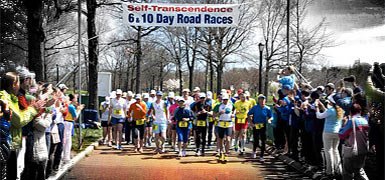
Although running a small loop for such a long time may sound crazy, it is a familiar concept to multi-day runners. Conventional 24 or 48-hour races, or slightly longer six and ten-day races, are generally held on a 400-metre track or a small road loop.
They are easy to manage logistically, as the essential food and drink needed to survive the event are available regularly each lap, along with medical attention and the important moral and physical support from personal helpers and race volunteers.
You can also send messages to the runners, which are printed off each day and handed to them at the race. They appreciate these messages like anything, knowing runners and friends from around the world are following their progress.
Want to visit the race to check things out? This is where you need to get to.
Do drop by and offer the runners some encouragement.
165-65 84th Ave, Jamaica, NY 11432
WHY 3,100 Miles?
The race is organised by the Sri Chinmoy Marathon Team. They have been organising ultra races globally for over 40 years. This will be the 29th edition of the 3,100 race.
The Sri Chinmoy Marathon team in New York started by organising their first ultra race over the classic 24-hour distance in the late 1980s. Ultra running was not the popular sport and pastime it has become today.
Sri Chinmoy (1931-2007), the founder of the marathon team, was a spiritual teacher, artist, musician, poet, and humanitarian. He also placed a huge emphasis on physical fitness and self-transcendence of the human spirit over adversity. A simple concept of always striving to push one's boundaries, that all running, especially ultra-distance running, embodies completely.
As runners competed and became competent at 24 hours, Sri Chinmoy encouraged his students to organise longer races to enable runners to challenge themselves further. 48-hour, 6-day, 10-day, 1,000-mile, and 1,300 and 2,700-mile races followed over the next few years until 3,100 miles was set as an ultimate challenge in 1997.
Although the race is officially 3,100 miles, after the customary celebration at 3100 miles, most runners continue and run the thirteen extra laps needed to reach 5,000 km, a distance at which national and international rankings are maintained.
THE 2025 RACE
Ten runners from nine different countries started the race. This year, the runners come from New Zealand, Poland, Russia, Romania, Italy, Slovakia, China, the USA, and the Czech Republic.
Sadly, Australian Multi-day specialist Annabel Hepworth was a late withdrawal due to injury.
Andrea Marcato, with five consecutive wins at the event, starts as the favourite. The 42-year-old Italian has the third fastest time for the race. He clocked 42 days, 17 hours, 38minutes, and 38 seconds in 2021.
Andrea is a former member of the Italian 24-hour squad, as well as being an experienced long-distance open water swimmer.
Vasu Duzhiy is a three-time winner in his 12 finishes at the race.
Another multiple finisher, Ananda-Lahari Zuscin, started his 21st, 3,100-mile race. He has a record of six finishes and just loves the special atmosphere the race creates.
In 2023, Mahasatya Janczak became the first Polish runner to complete the race. He is back for more and hopes to surpass his previous time of 50 days + 17:38:38
For Milan Javernicky, it will be his third attempt at the distance. In 2023, he came very close to accumulating 3031.5 miles in the 52 days.
Romanian Adrian Popic is returning with unfinished business. He struggled with shin and foot issues in 2023 but feels he learned a lot about his physical issues that will help him be stronger in this years race.
Harita Davies from New Zealand is running her 5th race. She has a best time of 50 days+13:23:14. That time, along with several intermediate distances are New Zealand national records.
Three runners are running their first 3,100-mile races
Daniela Bojilla from Italy has several competent 6 and 10-day races to her credit.
Lu-Cong Geng is the first Chinese athlete to run the 3,100-mile race. He is a very experienced multi-day runner and, if he paces things well in the early stages, should run well.
Alex Ramsay has run numerous 6 and 10-day races and will be relishing the challenge of taking on the 3,100-mile race.
Sadly, Australian Multi-day specialist Annabel Hepworth was a late withdrawal due to injury.
WHAT DO I GET FOR RUNNING 3,100 Miles?
A good question you might well ask?
With the only tangible reward at the event, a t-shirt a trophy and the usual spontaneous rounds of applause, runners must have their own special reasons for running such a long distance. Check out the 3,100 mile race runner video interviews HERE
Five-time winner Andrea Marcato offered his own thoughts.
”The name of the race says it all. Self-transcendence means going beyond your own limits to improve yourself. You become a better runner but also a better human being. You can become more capable of extending your skills in any field of life.”
At the end of the day, although extreme in nature, it is a race like any other with a start, a course, and a finish line. Just like an 800-metre or 5,000-metre race, it is a lesson for anyone in personal preparation, goal setting, planning, and execution. Several weeks of it!
Tejvan organises short-distance running and cycling races for the Sri Chinmoy Marathon Team in his home city of Oxford. He is also a very good cyclist, having won the National hill climb championships in 2013 and finished 3rd in the National 100 Mile Time Trials in 2014.
A video about the 3100 Mile Race which includes historic footage from 2005-2007, when the race founder, Sri Chinmoy came to the race. It also features interviews with runners from the 2024 race, who continue this initial inspiration in their own unique way.
View full article »
Day 42, October 10
By Tejvan Pettingerauthor bio »
11 October
About the author:
Tejvan organises short-distance running and cycling races for the Sri Chinmoy Marathon Team in his home city of Oxford. He is also a very good cyclist, having won the National hill climb championships in 2013 and finished 3rd in the National 100 Mile Time Trials in 2014.
Andrea Marcato reached 4800 km today, another personal total in 41:07: 31:14. Four and a half hours later, he reached 3000 miles for the fifth time in his 3100-mile race career in 41:12:14:17. He ran 68 miles for the day, which leaves him only 80.101 miles left. He has spoken that he will have a probable finish on Saturday morning. It will be known Friday evening when his finish will happen.
Budjargal Byambaa reached over 80 miles again for the third straight time, running 83.4 miles. He is now averaging 63.837 miles/102.736 km per day. He has passed 80 miles on 8 occassions in this year's 3100 Mile Race. He is in seventh place overall and is learning the way to make progress in the long, long races. Ashprihanal Aalto reached 2900 miles for the 17th time in 41:09:15:30. Shortly after that he passed 4700km in 41:09:34:14. Wei-Ming Lo is really moving well, as he reached 70.2 miles today. In the early morning he passed 4600 km in 41:01:43:00. Then he reached 2800 miles in 41:02:40:23. Pushkar was once again steady as possible, reaching 4400km in 41:00:24:45. Then in the late evening he passed 4500km in 41:16:50:08.
An event like the 3,100-mile race could not take place without the help of numerous volunteers.
Along with the core team from the local New York Sri Chinmoy Marathon, team, visitors come from out of town to help out.
Uddipan Brown
One of the furthest travelled visitors is Uddipan Brown, who we caught up with at the race.
Tarit. You are here helping at the 3100-mile race. First of all, where are you from?
Uddipan I'm originally from New Zealand, but now I make my home in Rarotonga, an island in the Cook Islands group in the Eastern Pacific Ocean.
Tarit. It seems we have helpers from all over the planet helping at this race. What inspires you to come here and help at this fabulous race?
Uddipan.I have been a runner for a very long time, and when I was competitively running, I really appreciated the incredible help and assistance that I got from the Sri Chinmoy Marathon team. So, once I finally retired from competitive running, I was inspired to offer that similar assistance myself. So I feel very much a part of this race, even though I am not running myself.
Tarit. We have all helped at little local 5Ks, 10Ks and even half marathons. Maybe the odd shorter ultra race. They are all done and dusted in a morning or a weekend at most. At this race, people are here helping for two weeks, three weeks or even longer. How long have you been here?
Uddipan. I have been here since before the start of the race on August 30th, and I am going to be here until the race is officially finished, on October 20th.
Tarit. WOW! So you are helping for the whole 52 days. That's quite an adventure in itself.
Uddipan. It is. It's a fantastic adventure, and I am learning a lot about myself. Not for nothing is it called the Sri Chinmoy Self-Transcendence 3100-mile race. I find myself transcending like anything every day in all the tasks that I am doing. I am just trying to do them better and better each day.
Tarit. So, what time of day do you come to the race? Is it a set time?
Uddipan. Well, my job is to shop for the race kitchen. There are other things that I do, but that is my main role. That starts at around about 8 am. I come in, and we talk over the shopping list. By 9 am, I am out on the road and shopping at various restaurant depots, supermarkets, or even tiny little Indian stores, depending on what the kitchen staff want on that particular day.
I have a budget that Rupantar ( race director) has given me, and so far, I have managed to keep well under that budget, so I am very happy about that. When I get back, I unload everything in the kitchen. Also, if any supplies are needed directly at the race, I take them straight there. Then, when I get back, I wash dishes in the kitchen, and then I have a wee break.
In afternoons, I am usually found at the race, helping with a lap counting shift. Then there are other things. Once a week, I am the overnight guard at the race village itself. That's on Mondays. Apart from that, I do anything that Rupantar asks me to do. Sometimes, we go and pick up propane tanks for the race site or fuel for the generator. Sometimes, Bipin will ask me to do something.
It’s a team effort. I don’t have bright ideas of my own. I just do what I'm told by all the experienced guys who intuitively know how to make the race run smoothly.
View full article »
Sri Chinmoy 3100 Mile Race - The first 30 days
By Tarit Stott
2 October
Cast your mind back to the morning of August 30th. What were you doing at 6 am that morning 12 runners set off on a 3,100-mile journey?
Although the distance seems immense, they are simply running around a 0.5488-mile block in Queens, New York, with every lap being meticulously counted. As we reach the end of September, a month later, They are still running, as the race has a 52-day cut-off.
Over the last month, several other sporting events have come and gone. In the running World, The UTMB trail races were happening in Chamonix at the start of September. The entire two weeks of the US Open tennis tournament took place just 5 miles away in Flushing Meadow Park. In the intervening time, in the multi-day world, six-day races have been held in Denmark and Hungary, resulting in new World Records (subject to ratification), for Denmark's’ Stine Rex and Belgium’s Matthieu Bonne. Just this past weekend, the Classic Greek trail race, the Spartathlon and the Berlin Marathon have been eagerly awaited, taken place, and consigned to history until next year. American ultra-runner Tara Dower recently completed her epic supported run along the 2,197-mile Appalachian trail, taking just over 40 days to complete the more undulating course!
All this time ..the 3,100 runners are still running every day around the famous 0.5488-mile block in Queens.
How are the runners doing collectively?
After the initial adrenaline-charged first few days things settled down.
Any endeavour of this length requires some good self-management and support and some good luck to negotiate all the multitude of challenges that can occur.
The perceived wisdom is steady, even effort each day is the best long-term strategy.
That is not to say that on any given day if the stars align, you don't just “go with the flow” and achieve a bigger daily total.
Care must be taken though, not to overdo it. Newton's immortal phrase, "With every action, there is an equal and opposite reaction,” certainly rings true for ultra runners as it does for Physicists. Making a determined effort one day, when feeling good to run a few extra miles, can lead to a consequent dip, if not the next day, then a couple of days later.
The same applies to food and fluid intake. You aren't just fueling with a few gels to get you through those last few kilometres of a marathon. In an extreme multi-day event like this, what you eat and drink today will affect how your body responds in 2 to 3 days.
Adequate regular fuelling is key to consistency, day after day.
In many ways, the 3100 runners are pioneers of extreme exploits. They prepare as best they can, but it is often said, that the preparation is just several years of consistent mileage and races to prepare the body outwardly, aligned with an inner determination in their lives to transcend themselves and push their personal boundaries out.
How are the runner’s doing individually?
Race leader Andrea Marcato has proved the steadiest in the first four weeks, avoiding injuries or major blister issues and keeping his energy levels fairly consistent.
He seems very much in control of himself. Four previous 3,100-mile completions had given him the experience to know how to “deal with himself” aided by his good friend and trusted main support crew, Arpan DeAngelo, himself a previous finisher of this race. At the finish of Day 32 on September 31st, Andrea had completed 2,318 Miles, averaging 72.4 miles a day.
Ashprihanal Aalto, the Flying Finn is making his 17th appearance in the race and is a nine-time previous winner. After making a flying start in the first week he has again settled into a routine. At one point, it looked like he and Andrea were in a race for the lead every day, but they have both, now settled into their own routines.
Lo Wei-Ming is running the race for the 4th time. He turned 60 this year and, throughout the race, has been bettering the World over 60 records for distances beyond 1,000 miles. He is the second 60-year-old to run this race. Scotland’s William Sichel completed in 2014 and set all the inaugural men’s Over 60 world records.
Pushkar Mullaer is back at the race, after a lengthy break. He has run very well, averaging over 67 miles. His best result was well back in 2012, where he finished in 48 days +8:22:16. At this rate, there is a chance he could set a pb, which would be a remarkable comeback race!
Vasu Duzhiy’s record of 11 finishes of the race has made him a solid competitor, who seems unflapable and knows how to manage himself in a multi-day. He can often be seen doing mobility exercises against fences and railings around the course.
Radu Budan, is competing in his first 3,100 mile race. As one of the first Moldovan to run beyond 1,000 miles, he is setting new national records at all major distances as his race progresses.
Annabel Hepworth is also running the distance for the first time. As the race progresses, she has been bettering many of the Australian records set by Sarah Barnett when she ran here in 2014. Her feet have taken a bit of a battering, but she is finding ways of managing the issues.
Budjargal Byamba came into his first 3,100-mile race with plenty of experience at 6/10 day races. He made an impressive start in the first two weeks, leading for a while, but then had minor injury issues to manage, which reduced his daily mileage. The injuries have subsided, and he has now settled back into a routine which should stop them from reoccurring. He is the first Mongolian to run the race, so he is also setting new Mongolian National records as the race progresses.
Already, it is apparent that barring a miracle, not all the runners will make the 52-day cut-off to complete 3,100 miles.
Stutisheel, Grahak, Nina and Ananda Lahari have all had different issues to deal with, meaning their daily distances have fallen below the 60-mile average needed to complete the race in the time limit.
Even in an average 100km or 100 mile ultra, there will be a certain percentage of runners who will bale out for a variety of reasons. In a fixed-time race, like a 24-hour or a 6-day, or in this case, 3,100 miles, there is always the goal of seeing just how far you can cover in the allotted time.
As Sri Chinmoy, the race founder, often said, “There is no failure.”
All multi-day runners know and understand this. The journey is just as much an experience as the final result.
On October the first, they still have 20 days to achieve their own personal goals.
By: Tarit
View full article »
Suprabha Beckjord - "This Is Real Life"
By Utpal Marshall
19 September
Article and video on Suprabha Beckjord, who ran and completed the first 13 editions of the Sri Chinmoy Self-Transcendence 3100 Mile Race.
“I love it, of course I always loved it when they would sing when I was running.” Sunday morning I caught up with Suprabha after she had been singing with the Enthusiasm Awakeners singing group. “It brightens the morning for the runners.”
Suprabha has a phenomenal history here at the Self-Transcendence 3100 mile race. She ran and completed the first 13 races accumulating a total of 40,300 miles on the course. Then if you add the first 2,700 mile race in 1996, well you can do the math. The circumference of the earth is just 24,901 miles.
Suprabha, Enthusiasm Awakeners (2018)
Asked if she had any doubts going into that first big race. “I guess I never ever thought whether or not it was possible to do it. I had enough inspiration and direction from Sri Chinmoy. He taught how to do one step at a time, one hour at a time, one day at a time.”
Interviewed during her 10th race in 2006, she said, “There are always new surprises in each race.” She took delight in the sheer volume of miles she was collecting over her many, many ultra races.
Ted Corbitt in 2005 was amazed that she kept coming back to the race. “It is amazing, just amazing.”
Suprabha, besides singing with the girls singing group, had also done a couple of shifts counting. “I felt I was here to be part of the race again. It invokes all kinds of feelings. That this is really my home and once you come back it feels as though you never left. I just felt the power of the race.”
Suprabha receiving prasad from Sri Chinmoy
She says that for her to be at the race, “This is real life, and this is Sri Chinmoy’s world. Everything else is kind of an illusion.”
My heart runs
The world’s longest race,
And not my mind.
My Lord runs ahead of me;
My breath runs behind.
Ray Krolewicz ran the Sri Chinmoy Self-Transcendence 3100 Mile Race in 2014. This is his story of how he came to do the race.
“Maybe I have hidden from some of my spirituality. I think this race has allowed me the time to really focus on that and what it means. Maybe recognize that I am not the greatest force in the universe.”
Ray Krolewicz in 2014
Ray Krolewicz is unique in so many ways. He is a perfect example of how one should never judge a book by its cover. His somewhat grizzly exterior would on first appearance not give you much of a clue as to the kind, intelligent, charismatic, and generous individual who lurks beneath his now sun browned torso. One that has rarely seen a shirt in 50 days and certainly not come close to any sunblock either.
All of us have beautiful and positive qualities within us. Though sometimes the world and more regrettably we ourselves tend to forget this great truth. But it is these bright aspects of ourselves that we are trying to expand and develop. And it is the darker portions of ourselves, the not so user friendly qualities, that we either wish to cast off, or more likely, to radically transform.
What sets Ray apart from the others here is that he is the only one who was personally encouraged by Sri Chinmoy to come here and run this race one day. When the invitation was given, he immediately asked, should I come this year. Sri Chinmoy’s timeless reply was, you will know when the time is right.
Ray in 2017
We can never control any aspect of time but for Ray something deep and significant was set into his heart that day those words were spoken. A 59 year old school teacher from South Carolina, whose lifelong passion has been distance running this race of course would be the logical culmination of his achievements in the sport. But with his best days perhaps slipping ever so subtly into the past. Maybe it was just too big and impossible a thing to attempt. It could easily have been an invitation to be ignored, if not forgotten. But there again is the Ray Krolewicz who does not take words and promises and dedication to unachievable goals lightly.
He had fashioned his own unique relationship over 30 years with this Indian Spiritual Master living in Queens. Now, even though he had passed almost 7 years ago, something inside of him at last called out. Something he could not ignore, despite all logic that might dictate the complete folly of his quest to run 3100 miles. Because of the man Ray is he knew but one option. He had to come to run this impossible race because the time was most definitely at last perfect.
“I had 30 years when the message should have been perfectly clear. From the day he picked up that shirt (at a race in 1984 when Sri Chinmoy picked up a shirt that Ray had thrown at a chair), till somewhere midpoint in this race. Dang, I had access to so much more. I have had opportunities. I have hidden from my own spirituality. That would be the culmination of that story that started 30 years ago. With this leader, this great man. This connection with the Supreme or God.”
“It finally all made sense somewhere when I was running around this block, and listening to people and sharing with people.”
“I remember Yuri from other races and I love his heart. he communicates so much without language. From a loquacious man like me I try to learn from him. Observation, feeling the heart. Observing him interact with others. Listening to him speak, with people who do speak his language.”
“I realize he has a lot to say, and what good ideas he has. He is well respected and loved as a competitor and a friend. You can observe this even if you don’t understand the actual words that people are saying.”
I ask how is it possible to see these subtle aspects when everything around him is so incredibly hard. “Me sensitive. Let’s dispense with this myth right away.” He jokes.
“2 different plains. When I ran 111 laps one day, I pointed out that it was physical, emotional, and spiritual. I may be in a lot of physical pain but I am not going to lose my empathy.”
I ask him if he thought when he came whether or not he actually believed he could complete the distance. “I came to find out. I stated before I started, that I didn’t know if I could do this. There are very few things that I ever attempted that I simply didn’t know.”
” I can go do 100 miles. That is easy. But to come here and do 60 a day, 3100 in 52 days. I had no idea if I could do it. But I wanted to find out.”
“I thought about quitting. I thought about quitting, going home and coming back for the finishes. Seeing what I could do to help. My friend Casey said, you don’t quit. Even if I have to come up there and drag you around the course, I will. And by golly she did.”
“She proved something to me and she proved something to her. She had never done 100 miles. She came out here and did well over 100 miles in the time that she was here. She suffered as much as any of the runners. This was her longest run.”
“I have so many supporters. I go home and put a little thing on facebook. The message over and over was. Doesn’t matter how much you do, you are amazing. You’re doing a great thing.”
“Somebody pointed out, you are only doing 40 miles a day. A 40 mile a week runner is a fairly serious runner. You are doing 52 days like a 40 mile a week runner would do in a year. I just realized at one point, that it wasn’t about any suffering that I may or may not be doing.”
“I have taken care of myself enough that I could learn. So that I could be here and help others. Doing a little writing and being Ray Krolewicz.”
Nirbhasa is from Ireland. He is an enthusiastic multi-day runner, having completed four times the Sri Chinmoy Self-Transcendence 3100 Mile Race - the longest race in the world.
This year's 3100 Mile race took place this year in New York in September and October. In addition there were two (at least that we know of!) solo runs of 3100 miles, inspired by the race's message of self-transcendence and the unlimited power of the human spirit.
On 14 June of this year, Frenchman Patrick Malandain began a 3100 mile journey on a in his home town of Montivilliers in Normandy. Patrick is no stranger to ultra endurance events, having completed 10,000 kilometers in less than 100 days in 2016. He completed his journey on August 3rd on Day 51 - an average of around 102 km per day.
On 17 September, Shamita Achenbach-König began her 3100 mile journey in her home town of Vienna, completing her 52-day journey on November 7. Previously, Shamita participated in the 3100 Mile Race in New York in 2016, and featured in the documentary film 3100: Run and Become.
View full article »
The Power of Meditation: a 3100 TEDx talk
By Nirbhasa Mageeauthor bio »
26 July
About the author:
Nirbhasa is from Ireland. He is an enthusiastic multi-day runner, having completed four times the Sri Chinmoy Self-Transcendence 3100 Mile Race - the longest race in the world.
Due to the pandemic, the 2020 3100 Mile Race was held in 2020 in Salzburg, Austria and Klaus Tiefenbrunner, a native Salzburger, had a front row seat! He spent many days at the race interviewing and filming the runners for an upcoming documentary, and became a real part of our 3100 race family.
Earlier this year, Klaus was invited to Samokov, Bulgaria to share his experiences of the 3100 mile race.
View full article »
We try and still the mind and focus on the heart
By Tejvan Pettingerauthor bio »
17 November
About the author:
Tejvan organises short-distance running and cycling races for the Sri Chinmoy Marathon Team in his home city of Oxford. He is also a very good cyclist, having won the National hill climb championships in 2013 and finished 3rd in the National 100 Mile Time Trials in 2014.
Nirbhasa Magee, who finished the 2020 edition of the Sri Chinmoy Self-Transcendence 3100 Mile race was featured in an article in the Meath Chronicle. Nirbhasa is a native of Summerhill, Co Meath in Ireland and currently lives in Iceland. After the race, he spoke to the paper about the challenges and experiences of this unique race. He also explains how practising meditation with Sri Chinmoy opened up many new possibilities, which led him to seek a sense of self-transcendence in both meditation and ultra-distance running. Speaking of the race, Magee said:
"You actually learn a great deal about yourself, participating in this race, which was probably the hardest of the four I've done. It's almost like your a different person coming out of the race than you are going into it, there's a definite process of personal change and transformation that takes place, a process of personal growth. You really have to expand yourself to get past the problems that you face."
Tejvan organises short-distance running and cycling races for the Sri Chinmoy Marathon Team in his home city of Oxford. He is also a very good cyclist, having won the National hill climb championships in 2013 and finished 3rd in the National 100 Mile Time Trials in 2014.
The 2020 edition of the Sri Chinmoy Self-Transcendence Race was held in Salzburg, Austria with five runners attempting to complete the 3,100 miles (nearly 5,000km). Usually, the race is held in New York, US, but due to Covid could not occur this year. Undaunted by the challenges of organising this epic race at short notice, a team of volunteers put on an excellent race around a scenic 1km loop in Salzburg. Although the race numbers were limited to five runners, the event required the dedicated support of helpers, cooks, counters and marshalls to ensure the safe running of this event. Event organiser Priyavadin Reisecker, who runs The Heart of Joy cafe in Salzburg, ensured that the race was able to offer this unique event in the new location. The organisers and runners also had to deal with one of the wettest autumns on record and frequent rain - which made the race more challenging for the 16 hour days.
The standout performance of the race was the remarkable achievements of race debutant Andrea Marcato (38) from Italy. His time of 43 days, 12 hours, 7 minutes is a record for a first-time entrant and the fifth fastest finish of all time. He also set multiple Italian distance records during his run and is now ranked fifth worldwide. After finishing he said:
“I am really happy that I basically covered all the distances, which are available in the world. So I am really happy and satisfied now. The feeling of deep satisfaction, inner peace and joy, which I perceived for a whole month after finishing 10-day races motivated me to run the world's longest certified road race. A feeling which I did not get after 24-hour races.”
A report of his final day is available here, and some of Marcato's statistics can be seen in this summary here.
In second place, was Austrian Ushika Muckenhumer (52) who lives serendipitously close to the course. He finished with a personal best time of 49 days, 14 hours, 13 minutes and was ably encouraged by his family and friends. During the race, he also received the particular support of the Austrian President who sent the runners a message of good wishes for their feats of self-transcendence.
“I can't even imagine what it is like to run constantly through 52 days. Yes, I like to go hiking for a few hours. But running 52 days, 118 marathons - unbelievable! What a breathtaking endurance performance. You are assured of my respect. I wish all participating athletes, especially the Salzburg local hero Hubert Muckenhumer, all the best, lots of success and the necessary perseverance for the next extremely challenging days of running ” (link)
The 3100 Mile Race
In third place was Nirbhasa Magee from Ireland. It was Magee's fourth finish out of four entries to the race - a great record made more remarkable for his period of illness during the race which left him with an understandable feeling of exhaustion. However, battling through tiredness, he walked for several days and was able to finish on the last day after accumulating a buffer in the earlier part of the race.
Ananda-Lahari Zuscin, 45, from Slovakia could not finish within the allotted time, but cheerfully raced for 51 days to accumulate 2799.6 miles. Zuskin has finished the race on six occasions and is one of the most frequent entrants, impressing watchers with his cheerfulness and determination, no matter how fast he is able to run.
Milan Javornicky, 46, from the Czech Republic was another first-time entrant and he achieved his own feat of self-transcendence, overcoming painful shin splints to manage 2,713.9 miles. Despite his obvious discomfort for much of the race, he was determined to keep going and run as best he could.
All five runners in their own different ways lived up to the ideal of self-transcendence, which Sri Chinmoy has made the heart of the race.
“I do not have any set goal; my goal is self-transcendence. I always try to transcend myself. I do not compete with the rest of the world. I compete only with myself, and I try to become a better human being. This is my ultimate goal.”
– Sri Chinmoy
Sri Chinmoy, a spiritual teacher himself was a notable athlete, running several marathons and ultra-marathons. He founded the 3100 Mile Race in 1996 as the ultimate test for runners to challenger their own physical, mental and spiritual limits. In particular, speaking at the first awards ceremony on 2 August 1997, Sri Chinmoy envisaged the wider impact of this special race to spread goodwill and peaceful energy.
Sri Chinmoy at the 3100 Mile Race in NY
"This 3,100 miles is an unprecedented journey in our world-peace-manifestation-dream. World-peace can come into existence only when we are inundated with patience and perseverance. Infinite patience we need in our inner life and perseverance we need in our outer life.
These 3,100 miles remind us of one divine and supreme reality: we can and we must do everything at our command to transform the world of lethargy and unwillingness to be dynamic. Unwillingness we do not leave behind us. Therefore happiness remains always a far cry. Willingness to give, willingness to achieve, willingness to grow and glow should be the message of our souls. With our souls' blessings we can and will fulfil our earthly life." - Sri Chinmoy
Local support
The race also captured the imagination of many locals who got used to seeing the runners and helpers out on the course. Many remarked on how they were inspired by the runners and how the race had a noticeable impact on the atmosphere of the park
"I've been noticing the tent for days, but I thought it was just one of the many charity events. Now I know the data, facts and background. You need time to really understand it. These five men make the impossible possible. We come here every day now." Race coverage local press
Local Kindergarten teacher Präauer was reported in the local press as saying:
"Since the beginning of the race there has been a subtle and even more clear change in the living space in our area. The peaceful coexistence becomes visible every day. Total strangers talk to each other, look at each other, are interested....There is a new openness for many who enter and use this park: walkers, runners, cyclists, children and again more children, dogs, people of many nationalities and in between the athletes who meditatively and actively dedicate their life to peace. I am happy with everyone who experiences this. And I am happy for the many children who are watching enthusiastically and are given new role models." Article on the race
The event has been covered in several papers across Europe including
Letter of support from Brother David to the runners
By Tejvan Pettingerauthor bio »
7 October
About the author:
Tejvan organises short-distance running and cycling races for the Sri Chinmoy Marathon Team in his home city of Oxford. He is also a very good cyclist, having won the National hill climb championships in 2013 and finished 3rd in the National 100 Mile Time Trials in 2014.
Dear runners in the Sri Chinmoy Self-Transcendence Race in Salzburg, my dear brothers,
Than you very much for the gift you give us all by your running. I, too, may - althrough from a great distance - participate in this magnificent festival of meditative sports: My thoughts and heartfelt blessings are with you.
In the spirit of Sri Chinmoy's understanding of sport, I wish each of you, that "sweet spot" where you simply become identical to your running. Then it's no longer about speed, it's no longer about any success; then you're just completely in the Now. But this Now is the fulcrum of a mysterious leverage through which your good intentions can lift the whole world higher towards the light.
Also to all helpers and all those who participate in this event, I would like to thank you an give them many good wishes.
In cordial connection
Your Brother David
---
Brother David Steindl-Rast is a world famous 94-year-old Austrian Benedictine monk who lived for 50 years in USA (Mount Saviour Monastery) and now he is living in Austria again for several years. He is also a well known author and has written many books. Brother David was always helpful and loving to the students of Sri Chinmoy. He calls them his brothers and sisters.
His first meeting with Sri Chinmoy took place, 1975 at the Interfaith Festival "Spiritual Summit Conference", where Mother Teresa also participated.
Nov. 2003: Meeting with Sri Chinmoy at "Aspiration Ground" New York
June 2017: Recieve "Torch Bearer Award", Salzburg, Austria from Sri Chinmoy Oneness-Home Peace Run.
Bruder David Steindl-Rast ist ein weltberühmter 94-jähriger österreichischer Benediktinermönch, der 50 Jahre in den USA (Mount Saviour Monastery) lebte und nun seit einigen Jahren wieder in Österreich ist. Er ist auch ein sehr bekannter Autor und hat viele Bücher geschrieben. Bruder David ist den Schülern von Sri Chinmoy sehr zugetan (er nennt sie „meine Brüder und Schwestern“) und hat sie nach außen immer unterstützt.
Sein erstes Treffen mit Sri Chinmoy fand 1975 beim Interfaith Festival „Spiritual Summit Conference“ statt, an dem auch Mutter Teresa teilnahm. Nov. 2003 Treffen mit Sri Chinmoy am „Aspiration Ground“ Juni 2017 Verleihung des „Torch Bearer Award“, Salzburg, Österreich.
View full article »
Audio: how I train for multi-day races
By Nirbhasa Mageeauthor bio »
9 January
About the author:
Nirbhasa is from Ireland. He is an enthusiastic multi-day runner, having completed four times the Sri Chinmoy Self-Transcendence 3100 Mile Race - the longest race in the world.
Most ultra-runners have to balance training for many hours a day with the demands of their regular life, and Jayasalini Abramovskikh is no exception, working at least 9 hours a day at her job as an economist. Jayasalini has run our 6 and 10 day race many times, and in 2014 became the first Russian woman to complete the 3100 Mile Race. She talks how she keep her really long runs for weekends and public holidays, how she varies her training, and (interestingly) how she prefers to undertrain rather than overtrain.
In her interview, she also talked about how she got into ultrarunning in the first place:
Video: Jayasalini talks about her 3100 Mile Race experience
View full article »
3100 Mile Race featured in video selection of Endurance Records
By Rupantar LaRussoauthor bio »
25 October
About the author:
Rupantar has been the race director of the Sri Chinmoy Marathon Team since 1985, having been asked by Sri Chinmoy to serve in that capacity. As well as working on the big races the US Marathon Team organise each year - the 3100 Mile Race and the Six and 10 Day Race - he also spends a considerable amount of time archiving the Marathon Team's 40 year history on this website.
The video channel Mad Lab features some epic records from around the world.
In this video, of 10 impressive records, they feature a short clip on the Sri Chinmoy Self-Transcendence 3,100-Mile Race - which is the world's longest certified footrace in the world. Video also features other distance records including most miles covered in 24 hours.
Photo: Pranjal Milovnik enroute to completing the 3,100 Mile Race in 2014.
View full article »
A first-hand account of running the world's longest race
By Nirbhasa Mageeauthor bio »
1 September
About the author:
Nirbhasa is from Ireland. He is an enthusiastic multi-day runner, having completed four times the Sri Chinmoy Self-Transcendence 3100 Mile Race - the longest race in the world.
Running in rhythm with the heart, Jayasalini Olga Abramovskikh's account of her epic finish of the Sri Chinmoy Self-Transcendence 3100 Mile Race, is now available in a new English translation.
In 2014, Jayasalini became the first Russian woman to complete the race when she crossed the line in 51 days, 12 hours and 31 minutes - less than 6 hours before the cut-off. Before she attempted this race, Jayasalini was also a regular participant in the Sri Chinmoy 6 and 10 day races held every April in Flushing Meadows, Queens, invariably finishing in the top three runners.
In the book - subtitled 'A book on the love of running, and the dream to cross the finish line of the longest race in the world' - Jayasalini talks about what inspired her to contemplate such a long race, her training and preparation, and her experiences during and after the race. Originally published in Russian, the English translation came out this month.
Nirbhasa is from Ireland. He is an enthusiastic multi-day runner, having completed four times the Sri Chinmoy Self-Transcendence 3100 Mile Race - the longest race in the world.
Sandhani Fitch has been marking and certifying courses for Sri Chinmoy Marathon Team races ever since the very first race in 1977; here he shares a few interesting details about how the now-famous course for the 3100 Mile Race - a half-mile loop around a high school, sports field and playground - came to be chosen.
I have worked on Sri Chinmoy’s running races since the very first Sri Chinmoy 10.6 mile race in Greenwich, Connecticut. Sahishnu (Sczeziul, associate race director) and I plotted a scenic course in northern Greenwich that was a hilly single loop. Sri Chinmoy had just begun his own personal distance running career and by the following year, with one more similar Sri Chinmoy race in New Canaan, Connecticut, we got some feedback from him. The first directive was to select flat courses! Secondly, Sri Chinmoy wanted aid stations at one-mile intervals for the runners. A year or two later he recommended using a one-mile loop for most of our races, no matter the overall distance.
These outer conditions that he proposed laid the foundation for the multi-day ultras he asked us to stage in the following years. The race directors in short time evolved into the team we have now. Sri Chinmoy always had faith that we had the willingness to do what he asked. We never questioned his requests, and with the amazing help provided by so many Marathon Team members in so many ways, his vision became a reality.
In the early 1990’s Sri Chinmoy asked if his students could stage a 2700-mile race! It took about 4 years of searching for staging areas for the race until we finally saw that no park was going to let us occupy an area around the clock for 47 days. He then said to stage it within 5 minutes of our neighborhood. We, in turn, asked about running for 18 hours and closing the course for 6 hours, and he said fine. We were then left with the choice between our current 2-mile race course around Jamaica High School, or what is now our 3100-mile course which I measured and submitted for certification. Our concerns were that it was only a little over a half mile and that it was a concrete sidewalk and not a softer “blacktop” surface. You know the course Sri Chinmoy chose.
Sandhani also has the job of patrolling the 3100 Mile course on his bicycle after dark.
Two general but profound things I have always felt about Sri Chinmoy’s races: First, he created them according to his vision, and was never bound by the conventions of the racing community. The distance or the time was always somewhat different, the previously mentioned conditions were applied to all the races, and the services and human contact with the participants provided by all the team members volunteering was very significant.
Second, and most meaningful to me, is what Sri Chinmoy brought to the earth consciousness in and through these events. God alone knows what he does, but I have always been able to feel it. The reason he could do this is because the races are totally his creation, and are made possible by the self-giving of all his students and volunteers and, most importantly, the willingness and determination of the runners to conquer these enormous distances. The Marathon Team makes the commitment to put on these huge races, because the runners themselves are so committed to complete the task put before them.
View full article »
3100 Mile Race over the years
By Nirbhasa Mageeauthor bio »
26 December
About the author:
Nirbhasa is from Ireland. He is an enthusiastic multi-day runner, having completed four times the Sri Chinmoy Self-Transcendence 3100 Mile Race - the longest race in the world.
Matthias van Baaren from Austria has given us many interesting graphics over the past couple of years, which helped inspire our charts display. He just sent us this interesting comparison of race times over the years, along with a few interesting tidbits; you can see the hi-res pdf version here »
View full article »
Day 42 graphs from Austria
By Nirbhasa Mageeauthor bio »
27 July
About the author:
Nirbhasa is from Ireland. He is an enthusiastic multi-day runner, having completed four times the Sri Chinmoy Self-Transcendence 3100 Mile Race - the longest race in the world.
Our interactive daily graphs on the homepage were inspired by the graphs that Matthias van Baaren from Vienna has been sending us since the beginning of the race (he also sent us the fun Chicken Run graphic from a couple of weeks ago). We havent been able to get around to putting them all up, but here are some graphs from day 42 just to give you an idea. Thank you very much Matthias!
Clicking on the images will open up the associated PDF's in a new tab.
Position changes during race:
Versus the 59.6 mile per day time limit:
Furthest and least mileage covered by runners, by day:
Predicted finish (based on average speed by day 42):
Relative position of runners:
Distance covered (days 36-42):
Daily mileage:
View full article »
Impressions of the 3100 Mile Race - A time-lapse video
By Nirbhasa Mageeauthor bio »
1 August
About the author:
Nirbhasa is from Ireland. He is an enthusiastic multi-day runner, having completed four times the Sri Chinmoy Self-Transcendence 3100 Mile Race - the longest race in the world.
This video was shot by one of our photographers during the 2013 race. The music is by Parichayaka Hammerl; the first track is his own composition and the subsequent tracks are his arrangements of Sri Chinmoy's melodies








 On 14 June of this year, Frenchman Patrick Malandain began a 3100 mile journey on a in his home town of Montivilliers in Normandy. Patrick is no stranger to ultra endurance events, having completed 10,000 kilometers in less than 100 days in 2016. He completed his journey on August 3rd on Day 51 - an average of around 102 km per day.


 Brother David Steindl-Rast is a world famous 94-year-old Austrian Benedictine monk who lived for 50 years in USA (Mount Saviour Monastery) and now he is living in Austria again for several years. He is also a well known author and has written many books. Brother David was always helpful and loving to the students of Sri Chinmoy. He calls them his brothers and sisters.
 Most ultra-runners have to balance training for many hours a day with the demands of their regular life, and Jayasalini Abramovskikh is no exception, working at least 9 hours a day at her job as an economist. Jayasalini has run our 6 and 10 day race many times, and in 2014 became the first Russian woman to complete the 3100 Mile Race. She talks how she keep her really long runs for weekends and public holidays, how she varies her training, and (interestingly) how she prefers to undertrain rather than overtrain.

 The video channel Mad Lab features some epic records from around the world.
 Running in rhythm with the heart, Jayasalini Olga Abramovskikh's account of her epic finish of the Sri Chinmoy Self-Transcendence 3100 Mile Race, is now available in a new English translation.
 Sandhani Fitch has been marking and certifying courses for Sri Chinmoy Marathon Team races ever since the very first race in 1977; here he shares a few interesting details about how the now-famous course for the 3100 Mile Race - a half-mile loop around a high school, sports field and playground - came to be chosen.


