
About the author:
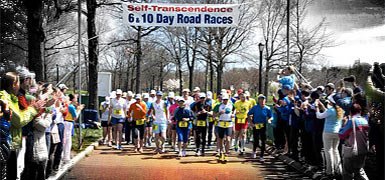
Tejvan organises short-distance running and cycling races for the Sri Chinmoy Marathon Team in his home city of Oxford. He is also a very good cyclist, having won the National hill climb championships in 2013 and finished 3rd in the National 100 Mile Time Trials in 2014.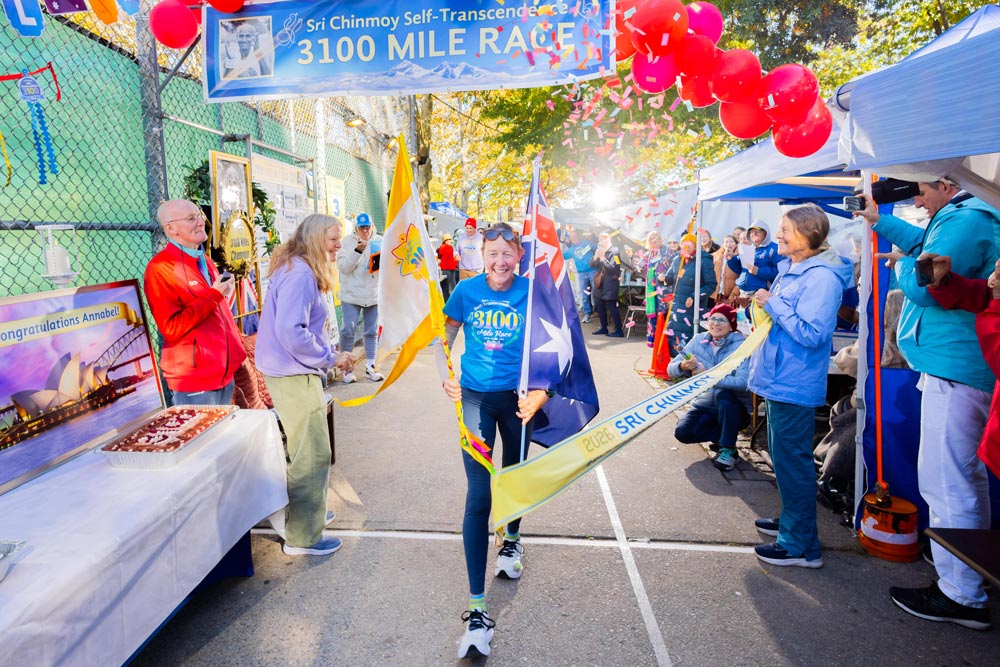
Tarit Stott interviews Annabel Hepworth - first place women in this years Sri Chinmoy 3100 Mile Self-Transcendence Race.
Post-race interview with Annabel Hepworth, women's winner of the Sri Chinmoy Self-Transcendence 3,100-Mile Race
Australia's Annabel Hepworth was the first woman to finish the 2026 race, in 49 days 9 hours 3 minutes 2 seconds. It ranks as the fourth-best time recorded by a woman at the event.
Along the way she set new Australian best performances at 2,000 km, 2,500 km, 3,000 km, 3,500 km, 4,000 km and 4,500 km, together with mile marks at 1,500 miles, 2,000 miles, 2,500 miles and 3,000 miles, and for the 3,100-mile race distance itself.
We caught up with her after the race to reflect on her achievement.
TARIT: So, here we are five days after finishing. How are you feeling?
ANNABEL: I think I'm feeling similar to how I would expect to feel after a six-day, if not slightly better.
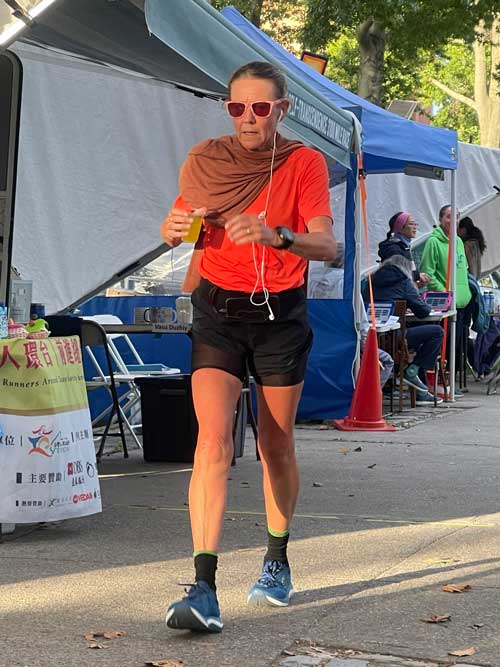 Here's a surprising fun fact: I looked at my heart rate variability perhaps a day after we'd finished. I looked at my watch, and it was 85, which is somewhere in my normal baseline — I tend to have a high-ish one. Normally, after a six-day, this particular metric tanks for three weeks. I've had the conversation with other runners and they all say, yeah, three weeks is the going rate for a plunge after a six-day. Actually, it had sorted itself out almost immediately after this race.
I think it probably tells you that I obviously wasn't "panning it" around the course for the last few days. It was very, very slow, and that's probably a lot to do with it. But how do I feel? I feel like I need more sleep.
I feel tired. I do not feel like running. I have zero desire to run right now, and that's absolutely fine.
Normally, when I'm in a foreign city, no matter how many times I've been there, my favourite thing to do is go out on walking tours. If I hadn't done this race, you wouldn't know where I'd be — I'd be hot-footing it around New York somewhere.
I don't even have the desire to do that this time. I just want to sit. I think there's a lot here to get back: I need a lot of sleep, and I need a lot of healthy eating for several weeks. A few fewer candy bars and a few more well-rounded meals.
TARIT: We will probably come back to diet a little later. But for those who don't know your background, briefly — and without the whole life story — was the younger Annabel interested in sport at school or as a teenager?
ANNABEL: I did little bits of everything. I was somewhere between the kid who would find excellent ways of having no gear for PE classes and, you know, stitching the textiles project to the press so I could sit there unpicking it.
I had no particular passion for any one sport. I played netball here and there, like every kid in Australia does, and a little hockey. But no — there was no love affair with running in high school. By university, though, I discovered I liked running.
It was a way of getting away from everything, and that's something I realised quite early. I've run all my adult life, and there was always something quite powerful about being somewhere 10 kilometres away and saying, "Let's go and do this or that, or see someone, and we'll run there." It was never "Let's go and do a race or an event." That all came later.
TARIT: So you obviously went through the classic progression — 10k, marathon, short ultra, going longer and longer. When did you do your first multi-day?
ANNABEL: Gosh, that's a good question. I think it was either 2013 or 2014 that I really got hooked. In 2013 I ran the Atacama Crossing, a stage race of around 250 km, and I also ran the Sri Chinmoy 24-hour in Sydney and a 48-hour that year. Then I ran Across the Years in Arizona over New Year — the 72-hour event, running from 2013 into 2014.
(The Atacama Crossing is a seven-day stage race across the Atacama Desert in northern Chile. Across the Years is a multi-day running festival in Arizona, featuring distances from 24 hours up to six days.)
Later in 2014 I ran the 72-hour race in Athens before taking on my first six-day race, in Adelaide. I think it was a tiny field and it was a lot of fun. So that was the 2013–14 period, and things just grew from there, with more six-day and then 10-day races.
TARIT: You obviously found you had a capacity for staying on your feet, which resulted in some good six-day and 10-day results and gave you a qualifier for the Sri Chinmoy 3,100-Mile Race.
(Annabel's personal bests are 758.798 km / 471.495 miles for six days and 1,102.476 km / 685.046 miles for 10 days.)
You've talked about the 2024 race in previous interviews — how it didn't go quite to plan, and you had to drop out with a foot issue after 2,185 km. That certainly didn't put you off, and you entered again in 2025, but had to withdraw before the race because of an injury.
(Utpal Marshall's 2024 video interview with Annabel: — and 3100 Mile Race interview)
You took good advice and adapted, and that let you solve your foot problems and other issues. This year, from day one, you seemed to have a completely different focus from 2024.
In practical terms, how do you divide up the day — or do you just go with the moment and let each day unfold?
ANNABEL: No, I'm heavily into process and time-based goals.
I've had some magic runs where I've gone and exceeded what I expected by quite a bit, but generally I'm as boring as they come and as consistent as they come. So if I plug that into a very time-based approach, I have a pretty good idea where it's going to get me at a certain point in the day, and a pretty good idea what time I can go to bed to get enough rest.
I found what worked for me in 2024, time-wise. That was to do a block until 2 pm — you could set your clock by it. I'd then have a half-hour break, come out at 2.30 pm and run straight through to about 10.30 pm.
It would vary by a few laps each day, but generally I would be where I needed to be for the minimum daily mileage, plus a few more. There was maybe one day when I had to stay out later because of the rain, when I lost so much time preparing and changing. But no, it was very, very time-based. You don't want to be rigid about it, but I knew what was working for me and I stuck with it.
It's a little different from a 10-day race strategy, where I've run long, long days — and I've run some good 10-day races doing that — but I couldn't comprehend doing the 3,100 that way. So a really time-based approach seemed to work.
TARIT: How often and how much do you eat each day? Are you a "little and often" person, or do you have a big meal every few hours?
ANNABEL: No, I'm absolutely little and often.
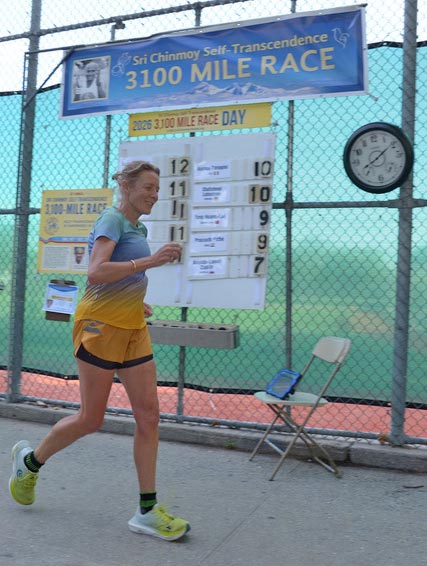 The day would look fairly typical. At the start, I was very much driven by what was on offer at the race feed station. Early on, I would specifically down three or four yoghurts, because you don't have to think about chewing the damn things. I know it's disgusting, but I didn't even use a spoon — I squished up the container so I could effectively drink it. I know that's not very ladylike.
Then we'd get the porridge, so I'd move on to that, and there were maybe three of those, and then I'd start to feel like I had carbohydrate in me. I might then down a bag of lollies, or some Tailwind, which is a high-carb drink. I know that's not ideal, but that's what I would do.
I really wanted to get carbs in at the start of the day. Then my helpers would make me eat more. I was quite particular about this: I liked fried eggs — I couldn't look at scrambled. I'd have fried eggs, a couple of cups of those, with toast wedges. After that I'd get more free-form, because what was on offer from the kitchen might vary each day. You knew you would have a steady stream of food to tuck into.
So I'd be starting on the lollies, which were quite high in sugar, quite early. Then we'd move into lunch, and I'd try to find whatever was starchy, but I didn't want to chew too much — I know that sounds lazy and really bad. There were a lot of smoothies available along the way, so I could get those.
I would snack and drink little and often through the afternoon.
When the nor'easter happened, it felt like an existential threat to me. I don't do well with the cold and the wind. I knew that, but it was worse than I'd anticipated, and I said to myself during it: you cannot go out on any lap without some carbohydrate in your hand or in your pocket.
Every lap, there must be carbohydrate consumption, because if that stops, the energy levels tank. I can't keep moving, and we're in a lot of trouble at that point. So, bizarrely, it set up what I consider some good practices. If you're on the little-and-often approach — and I am — just keep eating, and don't have big, long windows of food strike.
Every now and then, if I get despondent, for me it's usually caused by food strike. That isn't really an option in the 3,100, as it puts your own health at risk. You can get away with missing snacks in a six- or a 10-day race, but in a race as long as this, if you're not consistently fuelling and eating well, there's injury risk — let's be honest.
So I really had to find ways of dealing with that emotionally driven food strike and just not letting it happen: grabbing nutrients through smoothies and doing whatever I had to do to keep something coming in, even when I was feeling cranky because my feet were wet and I wasn't happy and had to do a shoe change. I had to really break away from that.
I have done it in shorter six- and 10-day races, but you just don't have the luxury of some of those petulant behaviours in this race, as every bad decision you make will come back at you with interest.
There's a multiplier effect for bad decisions in a race this long, and so much of it is just stopping yourself from doing things you know you shouldn't be doing.
TARIT: Are you aware that what you're eating on Monday is really feeding you for three or four days' time, in some ways?
ANNABEL: I was aware of it when Susan would offer me, say, a warm Tailwind at night, and I'd think, am I going to drink a sports drink at 10 o'clock at night, really? And then I'd think that the glycogen levels in my muscles will thank me in the morning. You have to keep a constant eye on your own ongoing day-to-day recovery, wondering how you're going to feel the next day, and the day after that, and the day after that.
Let's not kid ourselves: any serious weight loss will catch you out. You can't be doing this and thinking it's going to work well for you long term — and in this race you'll pay for it within a few days. It will come and bite you in all kinds of ways. It's hard, because it's a race where you're tired and mentally fatigued. There's this cumulative fatigue, and yet you've still got to haul yourself up by the bootstraps and force yourself to make good decisions, even when you want to be a toddler about it and throw your toys out of the pram.
TARIT: Do you have any idea how much weight you lost during the race?
ANNABEL: I actually think it was only a few kilograms. I don't weigh myself. I'm naturally lean and, unfortunately for me, I've got these long skinny arms and I'm stuck with them — nothing we do can change those. The rest of me isn't too bad, I think. So only a few kilograms, which I certainly want to put back on. At my age — 52 — I don't like feeling as though someone twice my size could bowl me over. It's not a comfortable feeling, so we're very much in the post-race eating phase at the moment, just getting all the calories back in.
TARIT: You had a good routine during the race of getting your miles done by about 10.30 pm. While some of the guys and gals ran right through to midnight, you opted for that extra hour's rest. Was that a deliberate strategy?
ANNABEL: Absolutely. It's a few things. Biologically, I think I have a really strong circadian rhythm, and I know this. It's why I've never been able to run a good 24-hour — I just can't get my head around staying awake for 24 hours.
(The circadian rhythm is the body's natural internal mechanism for regulating sleep and waking patterns. Multi-day running obviously has the ability to disrupt it.)
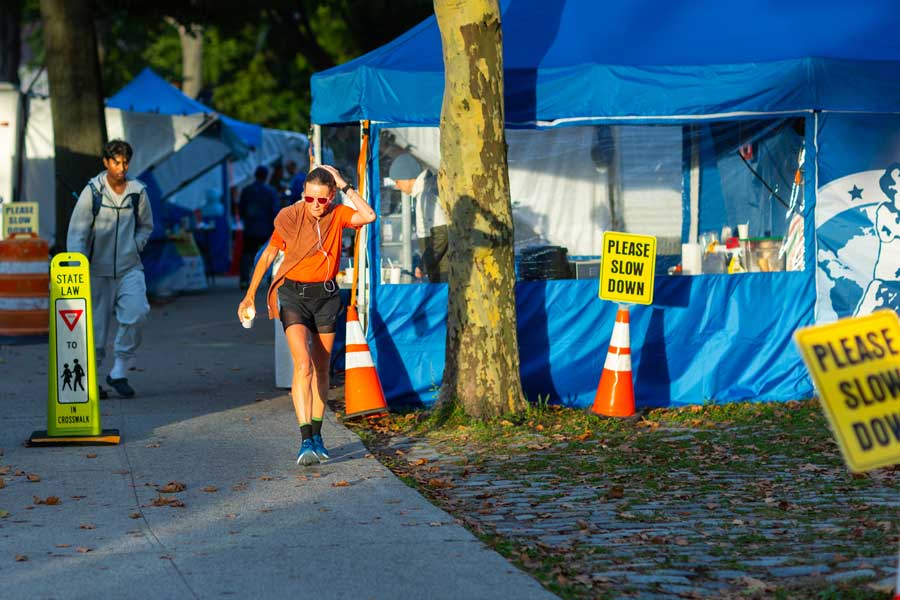 I can tell other people how to have a good 24-hour race, I can yell at them, I can do all the things — but for myself, there's no escaping how I feel at one or two in the morning. Yes, these things are trainable if you want to run a good 24-hour, right enough. I never actually did; I was always more interested in multi-day. And I've long taken the view that, for what I'm probably capable of, I should work with what I've got, which is to get the sleep and be fairly relentless when I'm on the course. That's how I've tended to approach it.
So it was absolutely deliberate. When I've done a 10-day and I'm running to, say, midnight, there's that psychological thing of counting those laps and those minutes down from about 10.30 pm onwards. I'm literally saying to myself: 90 minutes, 70 minutes. I'm counting it down, and it's the only way I can get through it. I couldn't get my head around the idea of counting it down for 52 days.
I also took the view: OK, for recovery, what do we know that works? No gadget is going to get you through this race by telling you how to sleep and eat. It was just that simple — sleep and food are really old school, but they're essentially all we've got to work with. So if I could get the miles done and get off to bed, that was what was going to work.
TARIT: By the time you got home and got yourself sorted, as all ultra runners have to, how much sleep do you feel you got each night on average?
ANNABEL: I was getting probably six hours in bed, but I was taking longer to fall asleep than I'd normally expect on a multi-day, as I was a bit wired. It got a little better as the race wore on.
My feet were kind of twitchy when I got home, and I did waste some time at night. I could have been in bed by 11 pm, but I tended to have a debrief with Susan, my helper. It just helped me to have a quick chat, to take myself out of the relentlessness of the race. If there was any threat of rain, we had to plan the foot care strategy for the next day: how often to change shoes; what was the weather forecast; did that change the shoe-change plan? I like to debrief. And then, to be honest, I'd maybe send an email or two and check my messages — things one probably shouldn't do, but I did, and I certainly put a cap on it. By 11.30 it was lights out, and Susan would go in and turn the shower on. We became more disciplined as the fatigue mounted, because I think we both knew I was tired and needed every minute of sleep.
TARIT: You obviously had a serious injury issue in 2024. Was there any point — notwithstanding the rainy days you've talked about in previous interviews — where you felt there was a risk of an injury coming on?
ANNABEL: I was talking to you earlier about that 2,185 km point, which is where, in my previous 3,100-mile race in 2024, I pulled up stumps and got driven to a podiatrist in Manhattan.
This year, psychologically, 2,185 km was one hour before my break. I passed that mark and it felt like the longest couple of kilometres of my life. I felt like I was at the end. I knew I just needed a reset at my break. The mental burden of it — this was such a serious thing to have happened in a foreign country two years ago.
At the same time, compared with 2024, my feet were looking really good. You'd look at the bottom of my feet and, once you got past the initial amusement at the toe angulation and so on, they actually looked pretty good, and they felt good. I was visually inspecting them every night.
There was a lot in 2024 that I couldn't understand. So I felt okay about the foot care and injury situation.
I had to. I knew going into the race that my baby toes were going to be a problem. One of them had been a problem in the 10-day race I ran in Bulgaria in April — I got a pinch blister, of all things. That's not an uncommon thing to get, but it was a pain.
We did cutouts; we did shoe surgery. Now, especially after this race, I'm increasingly of the view that shoe surgery is salvage therapy. It's a last resort. It's "do not go there until you have to go there."
To fix my pinch blister, we used to put an ENGO shear band — a zero-friction patch — around the toe, and it used to work. This time I felt it wasn't working any more. And I felt that using tape to restore normal anatomy carried the risk of skin tearing, and therefore infection. So I made a decision.
You're out there — I'm not a podiatrist, I'm just an experienced multi-day runner — having to make a decision about my own body based on my experience. You're guessing, I guess, is what I'm saying. But I felt that, all told, this was the way to go. So we went to shoe surgery, and we tried to make it as precise as we could.
And then, would you believe, I realised I had an ingrown toenail on my other baby toe. I looked at this thing — I've renamed it Eraserhead, after the David Lynch film — and the toe wasn't looking great. Again, it didn't look as though it was compromised, but there was an ingrown toenail and it was uncomfortable. So we did shoe surgery on the other shoe too, and I'm thinking, you couldn't make this up.
But those are luxury problems on these races. A baby toe pinch blister is highly unlikely to tip you over or take you out, unless it gets infected — in which case you're in a bit of trouble. So it was really about minimising infection risk. Otherwise I'd look at my toes and my feet and say, I can't believe these are my feet.
After I finished, I asked the doctors to look at my feet, the toes particularly, and Garima said to me, actually, we're going to look at everything, because that's what we're trained to do — not just look at what you're complaining about, but look at the totality of the foot. And then we all looked in wonderment, and had a laugh that these feet did this race without any real incident. That was a bit of a blessing, really, because 2024 was not for the faint-hearted.
TARIT: I think I mentioned earlier that, in my eyes and others', you are a pioneer of multi-day running. You're following in the footsteps of runners who did some crazy things 30 or 40 years ago.
ANNABEL: You mean like Sandy, Dipali and Eleanor? There are modern ones too, but yes, they're the main culprits.
(Annabel is referencing legendary runners such as Sandy Barwick, Eleanor Robinson and Dipali Cunningham, who pushed the boundaries for women in the 1980s and 1990s, setting — and in some cases repeatedly resetting — the records in women's multi-day events up to 1,000 miles.)
TARIT: There seems to be a new wave now in multi-day running, certainly at six- and 10-day.
ANNABEL: It's very exciting.
TARIT: Do you see — how can I put it — a role for yourself in inspiring other women to take on challenges that seem impossible?
ANNABEL: In a sense. I'm not someone who came at this with a story, with a history of fantastic 100 m, 400 m, half-marathon or marathon times — not even remotely. I'm a complete plodder, right?
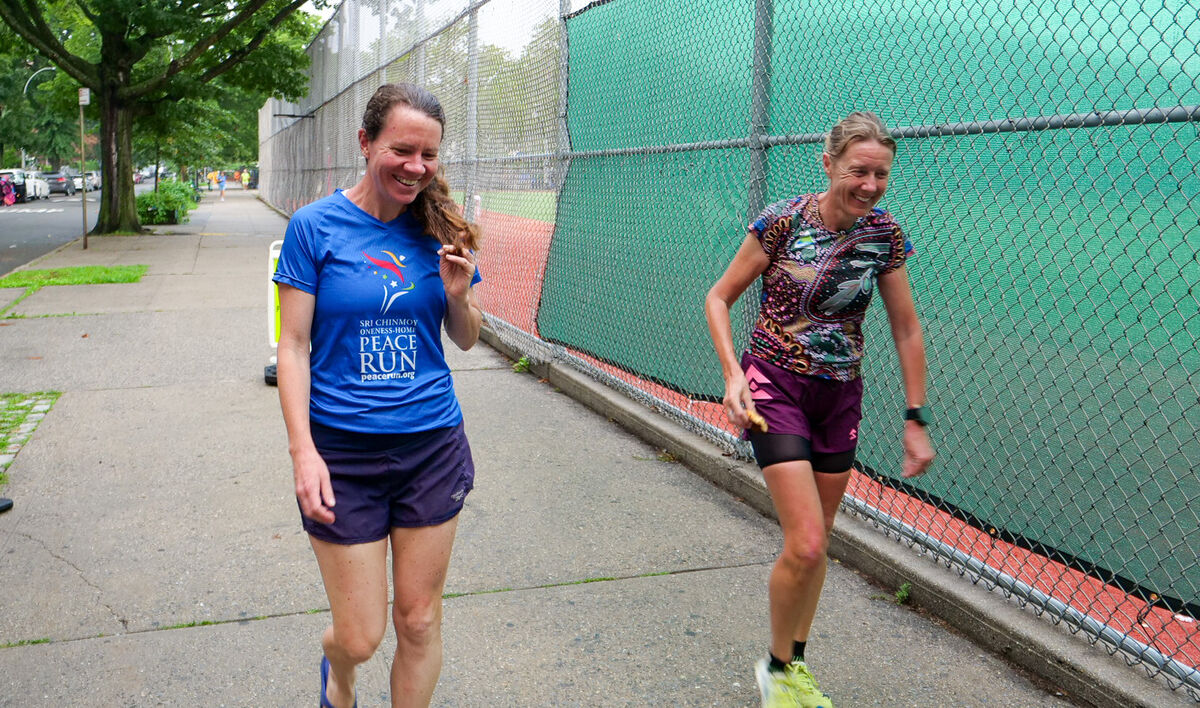 So if someone looks at this and says, well, I don't have a ton of leg speed — because I certainly don't — and if they see that by optimising the variables certain things might be achievable in the multi-day space, and if that inspires people, then great.
With learning to run multi-days, there are a lot of ways to skin a cat. You try out what appeals to you, you try out what other people are doing, and then you land on what works for you.
I think what works for people is going to change as we get runners with faster leg speed. I also think someone with more tolerance for sleep deprivation is always going to do better, and I think there's an element of that being trainable, in the six- and 10-day space especially.
So with the Meghan Eckert performance recently, breaching 1,000 km in a six-day for a woman — and looking at what the men have done too — the boundaries are really being stretched.
(American runner Meghan Eckert recently set a new women's world six-day record of 1,024.319 km / 636.482 miles.)
I think it will unleash a new wave of performances, with runners with more natural speed taking on the challenge of multi-day races, as we've seen at 24 hours.
Looking at some of the numbers at 24 hours — I don't think we'd have expected women to run these distances three, four or five years ago. I don't think we'd have expected a scenario like the recent World 24-Hour, where we got the kind of numbers we were seeing, certainly on the women's side, which is what I watched more closely. You didn't expect some of these records to be breached so quickly, in such fast succession, by a wave of runners. We're getting that at 24 hours, and now we're starting to see it in multi-day.
TARIT: So you're talking about the World 24-Hour standards, and about whether the top 24-hour runners can be tempted to try multi-days?
ANNABEL: Yes. I'm talking about the last World 24-Hour, where the top three women all broke the existing world record. I didn't think we'd see that in one race so soon. You probably know the numbers better than me, but we now have women hitting well over 260 km (161 miles), and even well over 270 km (167 miles), and nearing 280 km (174 miles) in 24 hours. I didn't think we'd see what we've seen so fast.
(The current women's world 24-hour record is 278.622 km / 173.127 miles, set by Great Britain's Sarah Webster at the IAU 24-Hour World Championships in Albi, France, in October 2025.)
I do think we're seeing that replicated in the multi-day space — not with the same numbers, because multi-days are more niche, and I think they will stay niche. But the number of multi-day runners is going to grow, and I think we're enjoying that growth.
It's going to be fascinating to see how things develop now that faster runners like Meghan Eckert are taking to multi-days, and whether it inspires more people to improve performances at all levels. Time will tell.
How many other women will now say: I'm a good 24-hour runner, I'm a good 48-hour runner, maybe I'm interested in going longer now? And where do some of them get to? I think it's going to be really interesting.
So, yes, the word "pioneer" is interesting. There was a certain window where I was there, and it was a different window from the one that had gone before me. It's changing rapidly again — and that's a good thing if it means more races and more choice for everybody.
It means it feels less lonely. It means you might have someone from your own country in a race with you, and that can be really important.
So yes, I'm really optimistic about where we are. It'll mean better races, better organisation and better governance. I think it's very exciting.
TARIT: Two final questions, then. Looking back on the race as a whole — here we are five days afterwards — do you have an overriding feeling about it? I mentioned Rupantar's classic observation at the awards ceremony, that "this race changes people's lives."
ANNABEL: It does, but that's all relative.
TARIT: Is there an overriding feeling you have, looking back on the experiences of the last 50 days?
ANNABEL: I haven't had time to digest it fully yet. You digest a lot of it when you're out there, but you're also having all these experiences — either the rain is trying to kill you, as is the wind, or you're having these moments of utter euphoria, or you're just laughing at something your handler said that is still amusing eight hours later and you're wetting yourself out there.
And between those experiences, you're processing the whole inner, spiritual side of it.
TARIT: Radu talked quite openly about just being in the flow state and not really understanding why or how — it just happens.
ANNABEL: Oh yes, I'm finding that. Some days did drag, but some days really were just: wow, where did those five hours go? Time moves.
I find the first six hours are slower, and then time moves faster. Most days felt smooth and calm and peaceful. It was a peaceful race for me.
When the schoolchildren were arriving and leaving, things felt a bit crazy, but when that's not happening there's an overriding sense of peace on this race. I had large slabs of feeling really at peace with the world.
TARIT: And lastly — you've now had the experience of the 3,100 and of finishing it. What advice would you give to someone reading this who has a dream that one day they might like to have a go at the 3,100-Mile Race?
ANNABEL: I'd just plug away at it. Looking at the ages of the participants, you don't need to be in your 20s, 30s or even 40s to do this race, so I'd say to people: you've got time.
There's no need to rush it. In fact, I'd caution against rushing. Get the experience on the shorter distances. Pushkar told me, at the 10-day race in Bulgaria this year, that he would often write notes at the end of a race, and that kind of thing is quite useful — make notes after all your big races about what worked well and what didn't, and commit them to memory.
So get some experience, but also don't be intimidated by a race like this.
There's a large element of luck. You definitely have to work out what your kryptonite is, and seek advice on what can be done to fix it. It's not always fixable. Some things are.
Not everyone can do this race; I think we've got to be realistic about that. But at the same time, work out what your weak points are and ask yourself, are they fixable? Because in a lot of cases, with the right approach and a fair bit of time, you can find a way around a lot of things.
That would be my best advice.
 More about: